
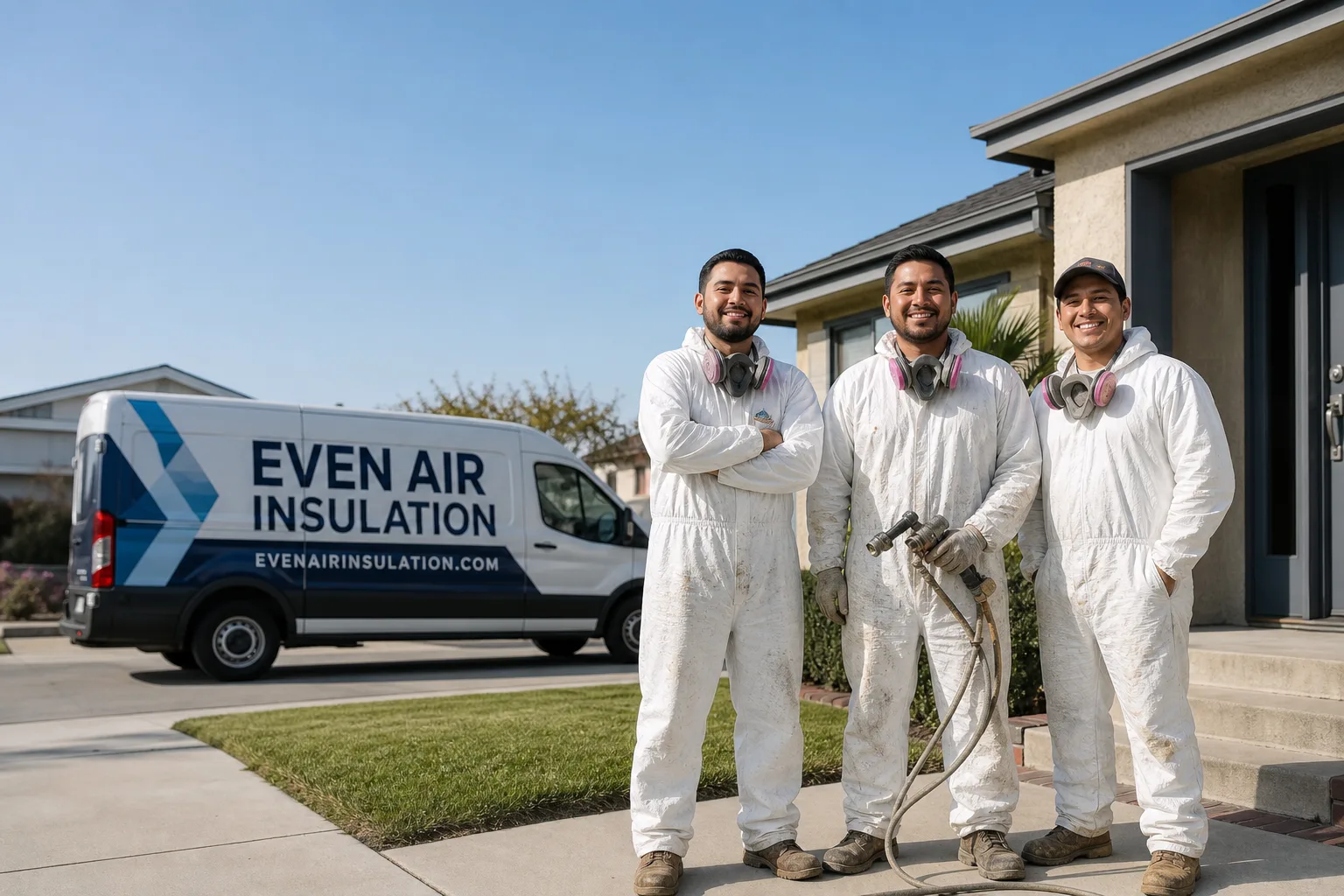
Fast, Reliable Spray Foam Insulation Across Whittier
Spray foam insulation in Whittier typically runs $2.80 to $6.50 per board foot installed, with most whole-attic retrofits landing between $4,500 and $11,000 depending on depth and formulation. Homes in the hillside neighborhoods above uptown and across Friendly Hills often need extra prep work like vent baffles and air-sealing before foam goes in, which affects both timeline and final cost. If your Whittier home has uneven room temperatures, persistent dust from Santa Ana winds, or summer cooling bills that climb every August, call Even Air Insulation at (855) 362-0195. We work throughout Whittier weekly and know which of the two spray foam formulations makes sense for your specific attic, rim joists, or crawl space.
Why Even Air Insulation Is Whittier’s Preferred Spray Foam Insulation Company
Whittier homeowners reach out to us most often after a general contractor or handyman recommends spray foam but can’t explain the difference between open-cell and closed-cell for their exact house. That’s where our multi-method approach pays off. We carry two professional-grade spray foam lines, Icynene and Demilec, and our crews are trained in both open-cell and closed-cell application. Our installers have worked bungalow attics near uptown, post-war ranch homes off Colima Road, and the steep-pitched hillside properties that climb toward the 90603 and 90605 zip codes.
Nelson Quirarte, who leads our crews, has walked hundreds of older Southern California attics and knows exactly what’s behind Whittier’s stucco-and-plaster walls. We don’t push spray foam when blown-in cellulose from GreenFiber or mineral wool from Rockwool would perform better for the job. Our product selection is application-driven, not inventory-driven. If you’re in Whittier and want a straight comparison of what each material costs and what difference it makes in your specific space, call us. Estimates are free and we’ll never recommend foam where it doesn’t earn its keep.
Rim Joist Spray Foam in Whittier
Rim joist spray foam in Whittier usually runs $850 to $1,900 for a typical 1,200 to 1,800 square foot single-story home, and it addresses a problem most homeowners in this city don’t realize they have: the band joist, that horizontal framing member where your floor meets your foundation, is often the single leakiest section of a 1950s ranch or 1920s bungalow. We routinely find gaps and cracks along rim joists in homes across the 90601 and 90604 corridors where dust from the San Gabriel Valley east winds finds its way into the house. Closed-cell foam applied to the rim joist seals the gap, slows air movement, and adds structural rigidity the old lumber has lost.
When Whittier Homes Need It
If winter mornings bring cold floors to the edges of your rooms, or if you notice a fine brown dust collecting in the corners of crawlspace-adjacent closets, the rim joists are usually the culprit. Homes with elevated foundations, common in the flatter tracts south and east of uptown, lose more conditioned air through rim joist gaps than through windows. Sealing them is one of the quickest, least disruptive insulation upgrades we do in Whittier.
How We Do It
Our crew accesses the rim joist from the crawl space or basement side, cleans the surface, and sprays a consistent layer of closed-cell foam along the entire perimeter. The foam expands to fill the irregular gaps where wood meets concrete. On Whittier homes with older crawl space vents, we’ll also assess whether those vents should stay open or be sealed based on how your specific foundation breathes.
Crawl Space Spray Foam Insulation in Whittier
Crawl space spray foam insulation in Whittier typically costs $3,200 to $7,500 for a full perimeter spray on the foundation walls of a standard crawl space, though prices shift based on access height and how much old batt material needs pulling out first. Many Whittier homes from the 1950s and 1960s have vented crawl spaces that were never insulated at all, and the result is flooring that never feels warm in January and cooling bills that climb in July and August. The fix is straightforward: remove whatever fiberglass is hanging and degraded, then spray closed-cell foam on the crawl space walls and rim joists to create a sealed thermal boundary.
Crawl Space Walls vs. Floor
Homeowners ask us whether to insulate the crawl space floor or the foundation walls. For Whittier’s mostly dry, mild climate, the answer is almost always the walls. Insulating the walls turns the crawl space into a conditioned buffer zone. Insulating the floor alone leaves the space cold and does nothing for the pipes running through it.
Old Vents and Santa Ana Dust
Whittier’s vented crawl spaces pull in dust every time the Santa Ana winds kick up, and that dust settles into insulation batts and degrades them over years. Closed-cell foam on the walls doesn’t hold dust the way fiberglass does, and it also blocks the air leaks where that dust enters. If you’re in the 90602 or 90606 ZIP codes and your crawl space smells musty or your floors feel drafty, this is worth a look.
Trusted Brands We Service in Whittier
Even Air Insulation works with eight residential insulation manufacturers, which means the product we recommend for your Whittier home is the right one for the job, not just the one we happen to stock. For spray foam specifically, we carry Icynene and Demilec, giving us access to both open-cell and closed-cell formulations. For Whittier homes where spray foam isn’t the best fit, we have GreenFiber blown-in cellulose, Owens Corning fiberglass batts, and Johns Manville products on hand. Having these options locally means faster turnaround for Whittier customers. If you’ve researched a specific brand and want to know whether it works for your attic or crawl space, call (855) 362-0195 and ask.
Common Spray Foam Insulation Problems We See in Whittier Homes
- Blocked attic ventilation from foam-over-without-baffles: Whittier’s hillside bungalows and Spanish-revival homes were built with gable and eave vents sized for cross-ventilation, not modern insulation. When foam is sprayed directly against the roof deck without building baffles first, the original venting gets blocked and the attic can’t breathe. We see this most often in the Friendly Hills area and the streets climbing above uptown.
- Knob-and-tube wiring buried in foam: Pre-war Whittier homes near uptown often still have active knob-and-tube circuits running through attic joist bays. That wiring stays hot during use and must remain exposed to air. Spraying foam over or around it without an electrician reviewing the circuit creates a real fire hazard. We don’t do that, ever.
- Closed-cell foam trapping moisture in 1950s stucco-and-plaster walls: Homes in the 90601 and 90606 corridors often have unsealed wall cavities and old plaster that moves moisture. If air leaks and moisture paths aren’t addressed before closed-cell foam goes in, damp gets trapped against the plaster, leading to staining and eventual deterioration.
- Santa Ana dust coating freshly sprayed foam: On exposed hillside properties, wind-driven dust packs onto open-cell foam surfaces and degrades the material long before its service life ends. This is why baffle-and-air-seal prep matters so much in Whittier. A properly prepped attic keeps the foam sealed and the dust out.
Pricing for Spray Foam Insulation in Whittier, CA
You can expect to pay between $2.80 and $6.50 per board foot for spray foam installation in Whittier. A full attic retrofit on a 1,200 square foot home lands around $4,500 to $7,000 with open-cell foam. Closed-cell, which adds an air and moisture barrier plus structural value, runs $5,500 to $11,000 for the same footprint. Rim joist sealing is the cheapest entry point at $850 to $1,900. Crawl space wall foam runs $3,200 to $7,500. Whittier homes with knee-wall attics, knob-and-tube wiring, or hillside access issues will see prep costs at the higher end. Call (855) 362-0195 for a free estimate. We’ll measure the actual space, not guess over the phone.
We Also Serve Cities Near Whittier
Even Air Insulation runs crews through South Whittier, West Whittier-Los Nietos, East La Mirada, and Santa Fe Springs every week. If you’re in one of those areas and need Spray Foam Insulation for an older home, the same prep standards and brand options apply. Our team is based in Koreatown, so we reach all of these communities quickly. Learn more about the areas we cover on our Whittier page.
Serving Whittier, CA — Our Local Coverage Area
We’re based in the Whittier area and know this community well. Use the map below to see our service coverage — if you’re nearby, we can almost certainly help.
FAQs About Spray Foam Insulation in Whittier
Spray foam can absolutely work in a 1920s bungalow, but the knob-and-tube wiring must be evaluated by an electrician before any foam touches the attic. Active knob-and-tube conductors need to remain exposed to air; burying them in foam is a fire hazard. Once the wiring is cleared or decommissioned, open-cell foam works well in those old Spanish-revival attics, especially paired with vent baffles. Call (855) 362-0195 and we’ll walk you through what clearing the wiring involves before we spray.
Those attics were originally built with gable and eave vents sized for cross-ventilation, not modern insulation. Without baffles holding a vent channel, spray foam blocks the original venting and the attic stops breathing. Santa Ana wind-driven dust then coats the foam and degrades it. We build foam baffles and air-seal top plates before spraying on hillside homes, which keeps the vents functional and the foam clean. It adds a day to some projects, but skipping it causes problems within a year or two.
For most 1950s ranches in Whittier, we recommend doing both at the same time, since the crew is already in the crawl space. If budget is a constraint, do the rim joists first. They’re the leakiest part of the thermal boundary and the cheapest to fix. Crawl space wall foam covers more square footage and costs more, but it delivers the biggest improvement in floor comfort and energy bills. We’ll quote both separately so you can decide.
In new construction, builders install foam before drywall goes up; in Whittier’s older homes, we’re injecting or spraying foam into wall cavities with old plaster, original framing, and sometimes knob-and-tube or early romex wiring inside. The prep is different. Air leaks and moisture paths have to be addressed before closed-cell foam goes in, or the foam traps damp against the plaster. That’s why we assess each wall cavity rather than doing a blanket spray. Call (855) 362-0195 if your 1950s stucco home has cold walls in winter and you want to understand your options.
Whittier’s climate is cooling-dominated. Hot, dry summers push radiant heat through uninsulated attics into living spaces, and that’s what drives most of the energy bills here. Spray foam on the roofline or attic floor blocks that heat at the source. Heating season is short and mild in Whittier, so the return on investment for cooling far outweighs heating. Most of our Whittier customers see the biggest difference in August, not December.
Spray Foam the Right Way in Whittier
Whittier’s older homes, from the bungalows above uptown to the ranch tracts off Lambert Road, need a contractor who understands the prep work before the foam goes in. Even Air Insulation does. We’re a multi-method insulation specialist carrying Icynene and Demilec spray foam, plus GreenFiber cellulose, Rockwool mineral wool, and fiberglass lines from Owens Corning, Johns Manville, Knauf, and CertainTeed. The right insulation for the job, not just the one we happen to stock. Even temperatures. Even energy bills. Even air.
Call Nelson and the team at (855) 362-0195 to schedule a free estimate. We’ll measure your attic, crawl space, or rim joists in Whittier, explain what prep your specific house needs, and give you a written number before any work starts.
Written by Nelson Quirarte, Owner at Even Air Insulation, serving Whittier and the San Gabriel Valley.