
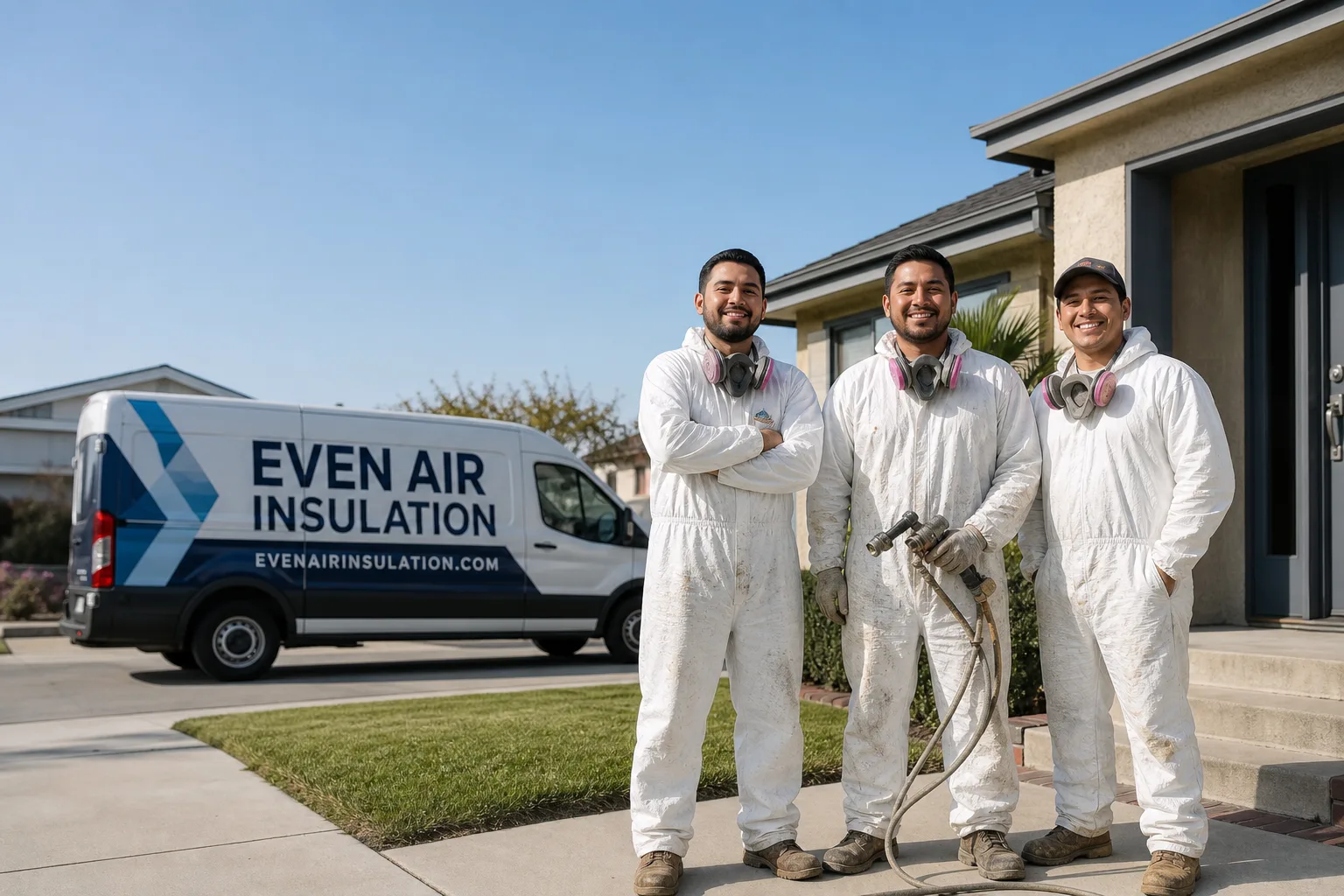
Fast, Reliable Spray Foam Insulation Across Santa Fe Springs
Spray foam insulation in Santa Fe Springs most often means sealing rim joists in 1950s stucco homes near the rail corridor, or applying heat-resistant foam to metal roof decks on warehouses along the 5 Freeway. That’s the reality of this city’s building stock, and it’s why our crews know to check the rail-side blocks for soot-contaminated insulation before anything else. We’re a multi-method insulation contractor, not a single-product shop, so the recommendation you get from us matches what your Santa Fe Springs structure actually needs. Call (855) 362-0195 for a free estimate and a straight answer about which foam formulation fits your job.
Why Even Air Insulation Is Santa Fe Springs’s Preferred Spray Foam Insulation Company
Our work in Santa Fe Springs has taught us what this city does to buildings. Heat cycling on metal-panel warehouses causes roof-deck foam to expand and delaminate in ways we don’t see in Downey or South Whittier. Homes along the Alameda Corridor collect a fine container-traffic grit that clogs vents and settles into blown-in blanket material. We know to look for that contamination first. Our Spray Foam Insulation team carries both Icynene and Demilec products, so we can match open-cell or closed-cell foam to the moisture and thermal conditions of each Santa Fe Springs building rather than forcing one product onto every job. Nelson Quirarte built this company around that approach: the right material for the application, not the one we happen to stock. Homeowners tell us the difference shows up in tighter envelopes and steadier indoor temperatures, and in the fact that we explain what we’re doing and why before we spray.
Rim Joist Spray Foam in Santa Fe Springs
Rim joist spray foam in Santa Fe Springs targets the band of framing where your floor meets the foundation wall, and in the older single-story homes near the city’s core, that’s almost always where outside air and rail-corridor grit get in. We see this constantly on the barrio streets west of the 5. The joist bays are short, access is tight, and the gap between the mudsill and the floor framing is the main air path into the house. Sealing it with closed-cell foam stops the draft, reduces dust infiltration, and cuts the cooling load your AC fights from May through October. A typical rim joist sealing job in Santa Fe Springs runs $900 to $2,200 for a small to mid-sized home, depending on linear footage and how much old fiberglass batt must be pulled first.
Why the Rail-Side Homes Need This First
Container traffic on the Alameda Corridor generates a continuous fine particulate that drifts into the neighborhood streets east of the rail line. We find it packed into rim joist cavities and settled across the top of old insulation. Sealing the rim with closed-cell spray foam creates a barrier that keeps that soot out of the living space and out of the insulation itself.
The Cellulose Cleanout Follow-Up
When rim sealing happens in a Santa Fe Springs home with contaminated blown-in material, the foam is only half the fix. We usually recommend a cleanout and a fresh dense-pack of GreenFiber cellulose to restore the attic’s thermal performance. That combination is what actually moves the needle on comfort and indoor air quality near the corridor.
Crawl Space Spray Foam Insulation in Santa Fe Springs
Crawl space spray foam insulation in Santa Fe Springs applies to the small subset of older homes here that sit on raised foundations, mostly scattered through the mid-century streets near Los Nietos and along Lakeland Road. These crawl spaces are shallow and ventilated, which lets hot, dust-laden air move under the floor during inland summer heat waves. Sealing the crawl space perimeter and band joists with closed-cell spray foam keeps that air out, stabilizes the space’s humidity, and stops the floor from radiating heat upward into the living room. A typical Santa Fe Springs crawl space encapsulation with spray foam runs $3,500 to $7,800 depending on square footage, access clearance, and whether the space needs a vapor barrier replacement.
Encapsulation in Santa Fe Springs’s Tight Crawls
The crawl spaces here are not like the tall basements in newer subdivisions. We’re often working in 18 to 24 inches of clearance between the floor joists and the dirt, especially in the 1940s stock near the old rail alignment. That means spray foam is often the only practical air-seal method, because it expands into the cracks and creates a continuous air barrier without requiring us to fit large batts into impossible spaces.
What We Seal First
The rim band is the priority in every crawl space we treat in Santa Fe Springs. After that, the subfloor gets a thin closed-cell layer if the homeowner wants direct insulation under their feet, followed by a clean vapor barrier over the ground. The sequence matters: air-seal first, insulate second.
Trusted Brands We Service in Santa Fe Springs
We’re not tied to one manufacturer, which means our Santa Fe Springs recommendations come from what the building needs. We carry Demilec for closed-cell applications where structural rigidity and moisture control are the priority, and we use Icynene open-cell when the job calls for air-sealing with sound dampening. For blown-in projects and rim joist cleanouts, we work with GreenFiber cellulose, and when batt fiberglass is the right tool, Owens Corning and Johns Manville are in our roster. That’s six of the eight brands we source, and it means Santa Fe Springs jobs get matched to the material, not the other way around.
Common Spray Foam Insulation Problems We See in Santa Fe Springs Homes
- Roof-deck foam delamination on metal warehouses: The heat cycle along the 5 Freeway corridor makes metal roof panels expand and contract daily. Summer temperatures regularly push the surface past 140 degrees, and spray foam that was applied too thin or without proper substrate prep will separate. We see it as lifting, bubbling, and adhesive failure at panel seams.
- Soot-contaminated attic insulation near the Alameda Corridor: Homes east and west of the rail spur accumulate a fine black grit that works down through the attic insulation and reduces its thermal performance. We find it most concentrated in the first two rows of houses off the corridor, where the air moves through ridge and soffit vents straight from the rail line.
- Incomplete rim joist sealing in tight barrio crawl spaces: The older homes near the city’s original grid have shallow, narrow rim bays. Installers not used to working in Santa Fe Springs’s tight clearances miss the outer corners or apply foam too thin. The result is persistent drafts and dust intrusion that the homeowner notices but can’t explain.
- Mobile home park underspray: Many of Santa Fe Springs’s mobile home parks have skirting-enclosed crawl spaces with metal and wood framing mixed together. Foam applied without assessing the metal expansion rates will crack and pull away from the panels within two summers. Matching the foam chemistry to the substrate matters more here than in a standard frame home.
Pricing for Spray Foam Insulation in Santa Fe Springs, CA
Rim joist sealing in Santa Fe Springs typically runs $900 to $2,200 for an average mid-century home. Crawl space encapsulation with closed-cell foam on the perimeter and band joists falls between $3,500 and $7,800. Attic roof-deck applications for residential homes run $4,200 to $9,500, and commercial warehouse roof-deck work is priced by square foot, usually $4.50 to $7.00 per square foot depending on foam type, thickness, and whether we’re removing delaminated material first. Santa Fe Springs’s labor market and the frequent need for contamination cleanouts on rail-side streets push costs slightly above neighboring Downey or Pico Rivera. Call (855) 362-0195 and we’ll give you a written number based on your street, your building, and what we actually see in the space.
We Also Serve Cities Near Santa Fe Springs
Even Air Insulation runs crews into Santa Fe Springs weekly, and we regularly take spray foam jobs in West Whittier-Los Nietos, Downey, Pico Rivera, and South Whittier. The building stock changes block by block around here, so we treat each city’s homes on their own terms rather than applying one template to the whole basin.
Serving Santa Fe Springs, CA — Our Local Coverage Area
We’re based in the Santa Fe Springs area and know this community well. Use the map below to see our service coverage — if you’re nearby, we can almost certainly help.
FAQs About Spray Foam Insulation in Santa Fe Springs
Closed-cell spray foam on metal roof decks in Santa Fe Springs holds up well when it’s applied at the right thickness and with proper adhesion, but poorly when it’s rushed. The city’s summer heat cycle expands metal panels daily, which causes delamination at the panel seams if the foam is too thin or the surface was not prepped. We use Demilec closed-cell for these jobs because it bonds firmly to metal and resists the shear forces that develop as panels move. Call (855) 362-0195 and we’ll walk you through what a roof-deck re-foam actually involves.
Homes near the Alameda Corridor in Santa Fe Springs accumulate container-traffic soot that clogs ventilation and settles into blown-in insulation, degrading its performance. The fix is specific: we remove the contaminated material, seal the rim joists with closed-cell spray foam to block further intrusion, and often apply a radiant barrier to reduce attic heat gain. This sequence addresses both the contaminant problem and the cooling load that makes these homes expensive to condition in summer.
Yes, and we do it regularly. The catch is that mobile home skirting and underfloor framing mix metal and wood, and the foam chemistry must match the substrate or it cracks and pulls away during thermal cycling. Our crews know which Demilec and Icynene formulations work on which surfaces, and we check access clearances before quoting. Most mobile home underfloor spray foam jobs in Santa Fe Springs run $2,800 to $5,500.
For the single-story stucco homes built between the 1940s and 1960s here, we typically recommend closed-cell spray foam on the rim joists and, where the attic is vented, a radiant barrier plus new blown-in cellulose rather than foaming the entire roof deck. That combination targets the actual failure points in these homes: air infiltration at the framing and inadequate attic thermal resistance. It also costs less than full roof-deck foam, which is rarely necessary in this housing stock.
We bring our spray rig in early, coordinate the truck placement with the homeowner or facility manager, and work in sections so we’re not blocking an alley or a shared driveway. In the older barrio blocks and mobile home parks where parking is tight, we use shorter hose runs and park the rig at the nearest legal spot, even if it means carrying material a short distance. It adds a little time to the day and we plan for it.
If you’re in Santa Fe Springs and the heat, the dust, or the energy bill is telling you something’s wrong with your insulation, call (855) 362-0195. We’ll tell you straight what the building needs, what it costs, and how long it’ll take. No script, no upcharge games.
Written by Nelson Quirarte, Owner at Even Air Insulation, serving Santa Fe Springs and the surrounding basin.