
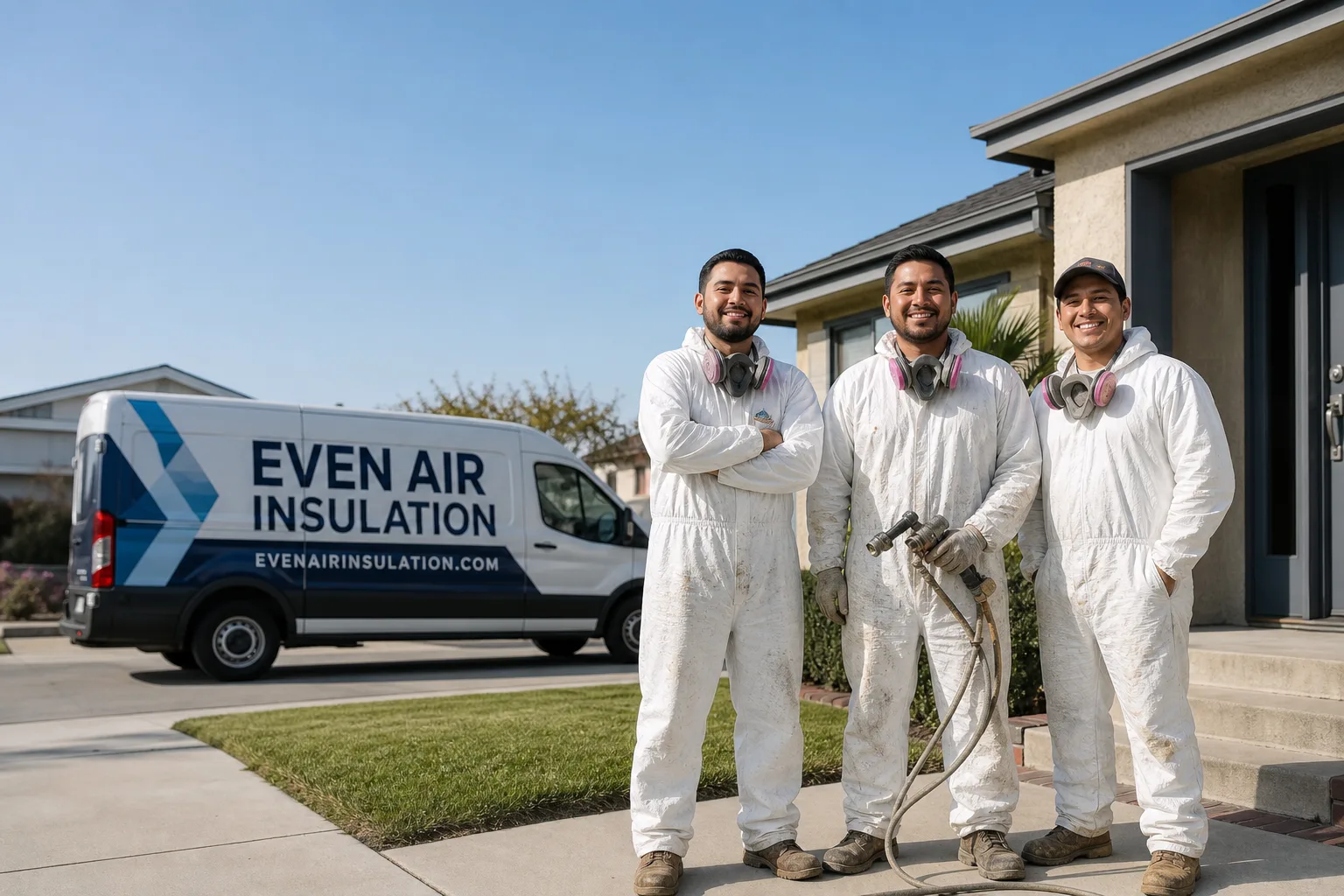
Fast, Reliable Spray Foam Insulation Across Baldwin Park
Spray foam insulation in Baldwin Park typically runs $2,200 – $6,800 for a full attic retrofit, with wall injections and rim joist work landing between $900 and $3,400 depending on square footage and access. Most 91706 homes we see are 1950s – 60s stucco ranches with original or badly compressed insulation, so the real job is air-sealing and foam adaptation, not just spraying material. We’re a multi-method insulation specialist, which means we’ll tell you honestly whether spray foam is the right call for your Baldwin Park home, and if it is, we carry both Icynene and Demilec product lines. Call (855) 362-0195 for a free estimate and a straight answer about what your attic actually needs.
Why Even Air Insulation Is Baldwin Park’s Preferred Spray Foam Insulation Company
The homes we work on in Baldwin Park aren’t new builds. They’re post-war tract houses off Ramona Boulevard, Merced Avenue, and Puente Avenue, where the attic has maybe two inches of compressed rock wool and the upstairs bedrooms cook every summer afternoon. Our techs know that 91706 housing stock before they even climb the ladder. That local familiarity changes the work we recommend. You don’t need a sales pitch about R-values when the real problem is a low-pitch roof deck hitting 140°F and a dozen unsealed top plates leaking conditioned air into the attic.
Nelson Quirarte, who leads Even Air Insulation, built the crew around the idea that material choice should follow the house, not the inventory sheet. We carry eight manufacturer lines because a 1958 stucco ranch in Baldwin Park needs something different from a newer two-story off Francisquito Avenue. The reputation we’ve built with Baldwin Park homeowners comes from explaining that difference clearly, quoting honestly, and showing up when we say we will. If you call us from anywhere in the 91706 ZIP, you’re talking to a team that’s already worked on homes like yours within the last month.
Our Spray Foam Insulation crew specializes in retrofit work on aging housing stock, which is most of what Baldwin Park throws at us. We respond to Baldwin Park service calls throughout the week, and emergency calls for a compromised attic or a failed retrofit get priority same-day scheduling whenever possible.
Spray Foam Wall Insulation in Baldwin Park
Spray foam wall insulation in Baldwin Park usually means injecting slow-rise foam into the closed wall cavities of a 1950s – 60s wood-frame stucco home, and it runs roughly $3,200 – $8,400 for a full exterior wall treatment on a typical single-story ranch. The wall cavities in these tract homes are often empty or holding a thin layer of settled fiberglass, and the stucco exterior means you can’t just pull siding off to insulate. Slow-rise open-cell foam fills the cavity around old wiring and plumbing without pushing the drywall out, which matters in houses where the interior plaster is already 60 years old.
We do this work regularly for Baldwin Park homeowners who have tried everything else, new windows, new HVAC, even a radiant barrier, and still have bedrooms that won’t hold temperature. The walls are the missing piece in an older home. When the attic is sealed and insulated but the walls are hollow, heat still radiates through the stucco all afternoon and the interior never feels stable.
How wall foam behaves in stucco construction
Stucco holds heat. In Baldwin Park’s inland valley summers, a west-facing stucco wall absorbs sun from noon until sunset and radiates it inward for hours. Open-cell foam slows that transfer dramatically, but only if the wall cavities are treated properly, including the top plates where the wall meets the attic. We always pair wall foam with top-plate sealing, because skipping it means hot attic air still leaks down into the walls and the foam underperforms.
When to prioritize walls over attic
Some Baldwin Park homes already had attic work done, either blown-in cellulose or an earlier foam job, but the upstairs still bakes. That’s usually a wall cavity problem. We’ve seen it on homes along Maine Avenue and in the tracts south of the 10, where afternoon sun hits the same wall surface for six or seven hours. If your attic is genuinely sealed and your rooms still spike, wall injection is the next logical step, and we’ll tell you that before we sell you anything.
Rim Joist Spray Foam in Baldwin Park
Rim joist spray foam in Baldwin Park addresses the band board that runs around the perimeter of your foundation where the floor framing meets the concrete, and a full rim joist treatment typically costs $900 – $2,600 for a single-story 91706 home. The rim joist area in these older post-war houses is often uninsulated, which means outdoor air moves freely into the space between floors and up through the walls. In winter, it’s the reason your floors feel cold even when the heat is running.
For Baldwin Park homeowners dealing with multi-generational households and bedrooms on concrete slabs, rim joist sealing matters more than people expect. Cool air pools at the floor level, and in homes where grandparents or young kids spend time close to the ground, that temperature difference shows up in comfort complaints even when the thermostat reads normal. Closed-cell foam seals the rim, blocks air movement, and adds structural stiffness to the band board.
Why rim joists matter in slab-adjacent rooms
Many Baldwin Park ranches have additions or converted garages with slab floors. The rim joist along those slab edges is a direct path for outside air to enter the wall cavity and travel upward. We seal those with closed-cell foam before doing any wall or attic work, because a sealed thermal boundary starts at the bottom of the wall, not the top.
Rim joist work as part of a full retrofit
Most Baldwin Park retrofits we quote include rim joist treatment as part of the attic and wall scope, because it’s relatively quick work but has an outsized effect on how the whole house feels. If your floors are cold in January or you can feel a draft along the baseboards in an older room, the rim is the first place we look.
Trusted Brands We Service in Baldwin Park
We carry Icynene and Demilec spray foam products because Baldwin Park’s housing stock demands both open-cell and closed-cell options depending on the attic, the wall cavity, and the roof deck condition. Icynene closed-cell goes on roof decks and rim joists where structural strength and moisture resistance matter most, while Demilec open-cell fills wall cavities in older stucco homes where breathability and flexibility are the priority. We also stock GreenFiber cellulose for Baldwin Park homes where blown-in insulation makes more sense than foam, and CertainTeed fiberglass for standard batt applications. The local advantage is simple: we hold inventory for these brands and common retrofit scenarios, so a Baldwin Park homeowner waiting on a specific product isn’t waiting weeks.
Common Spray Foam Insulation Problems We See in Baldwin Park Homes
- Foam over old compressed rock wool without air-sealing first. Many 91706 attics still have the original rock wool, flattened to an inch or two. Spraying foam over it without sealing the top plates and wiring penetrations traps heat and moisture under the foam instead of reducing the attic load.
- Too much foam on aging roof decking. Homes built in the 1950s and 60s have roof decking that doesn’t always handle a thick closed-cell application well. Over-spraying the underside can trap moisture in the drywall below, especially in Baldwin Park’s dry summers followed by odd winter rain patterns. The deck needs to be assessed first.
- Skipped rim joist and top-plate sealing on stucco tracts. Spray foam in the walls underperforms when the attic still leaks hot air into the living space through unsealed rim joists and top plates. We see this constantly in homes where someone did a partial foam job years ago.
- Ventilation added as an afterthought. Low-pitch attics in Baldwin Park need ventilation designed around the foam, not just a ridge vent thrown on later. When foam seals the attic but the airflow isn’t right, the upstairs rooms still struggle and the roof deck ages faster.
Pricing for Spray Foam Insulation in Baldwin Park, CA
Expect to pay $2,200 – $6,800 for a full attic spray foam retrofit in Baldwin Park, $3,200 – $8,400 for complete wall cavity injection, and $900 – $2,600 for rim joist work on a typical 91706 ranch. Garage ceiling foam runs $1,100 – $2,800 depending on whether it’s an attached garage with living space above. Roof deck applications on low-pitch attics add cost because of access and ventilation requirements, often $4,500 – $9,500 for a full deck treatment. Square footage, attic clearance, and existing insulation removal all move the number. We quote free, we quote in writing, and we don’t pad the estimate with work your Baldwin Park home doesn’t need. Call (855) 362-0195 for an exact price on your home.
We Also Serve Cities Near Baldwin Park
Even Air Insulation works throughout the San Gabriel Valley, including Baldwin Park and the surrounding communities of Duarte, Irwindale, Bradbury, and Avocado Heights. The housing stock in these areas mirrors Baldwin Park’s: 1950s – 60s stucco ranches, low-pitch attics, and retrofit needs rather than new construction. If you’re in one of these cities and dealing with the same hot-attic, cold-floor problems, call us at (855) 362-0195.
Serving Baldwin Park, CA — Our Local Coverage Area
We’re based in the Baldwin Park area and know this community well. Use the map below to see our service coverage — if you’re nearby, we can almost certainly help.
FAQs About Spray Foam Insulation in Baldwin Park
Yes, spray foam works in low-pitch 1950s Baldwin Park attics, but only when it’s applied with air-sealing and ventilation designed for the space. These attics have very little clearance, so our crew works in tight conditions to seal top plates, wiring penetrations, and the rim before foam goes down. The foam itself is only half the job in a 91706 tract home. Call (855) 362-0195 and we’ll assess your specific attic before recommending anything.
The best spray foam upgrade for hot upstairs rooms in a Baldwin Park stucco ranch is usually roof deck foam combined with top-plate sealing and targeted wall injection. The roof deck is where the 140°F attic heat is being absorbed, and the walls are where afternoon sun loads the interior. We quote both together when the home needs it, because doing one without the other leaves the upstairs still struggling. Estimates are free, call (855) 362-0195.
Yes, in most 1950s – 60s Baldwin Park homes, the old compressed rock wool or settled fiberglass needs to come out before spray foam goes in. Leaving it under the foam creates a thermal gap and can trap moisture. Removing it also lets us see the bare joists and assess the roof deck, which matters in older homes. We include removal in our retrofit quotes for 91706 homes.
Spray foam outperforms blown-in insulation in Baldwin Park’s dry summers because it creates an air seal, not just a thermal barrier. That matters when attic temperatures spike well above 110°F and the real enemy is hot air moving through gaps. Blown-in cellulose from GreenFiber works well in the right homes, but when air movement is the problem, closed-cell Icynene or Demilec foam is the stronger prescription. We’ll tell you which your house actually needs.
Yes, spray foam is often worth it for Baldwin Park’s multi-generational households because it addresses the temperature imbalance between upstairs bedrooms and downstairs living areas, which is exactly what causes friction when multiple generations share one roof. Grandparents in downstairs rooms feel cold floors in winter. Kids upstairs bake in summer. A proper air-seal and foam retrofit evens out those differences. Call (855) 362-0195 for a free assessment if this sounds like your house.
Written by Nelson Quirarte, Owner at Even Air Insulation, serving Baldwin Park and the San Gabriel Valley.