
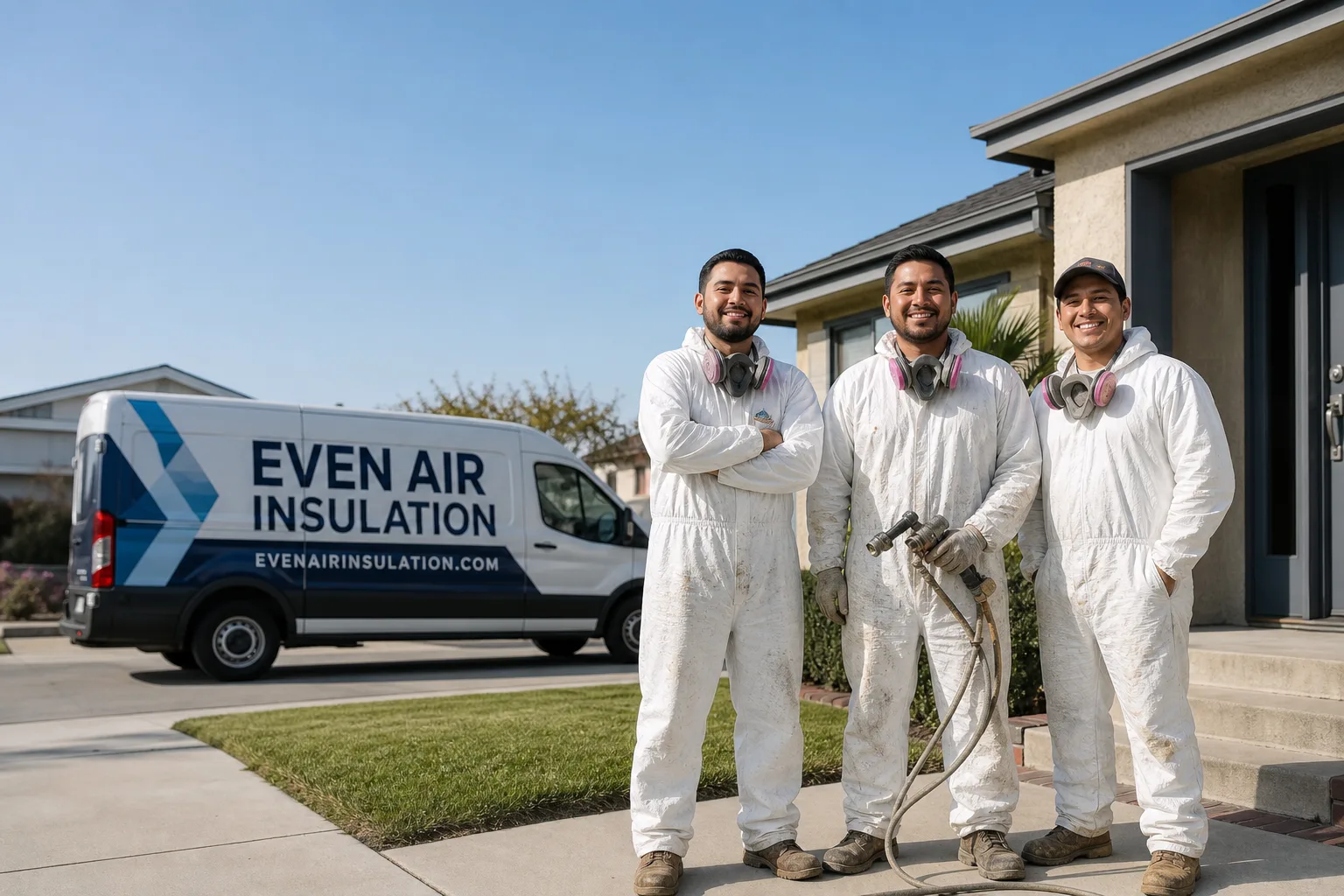
Fast, Reliable Spray Foam Insulation Across Avocado Heights
Spray foam insulation in Avocado Heights runs $1.75 – $4.50 per board foot installed, depending on whether your project calls for open-cell or closed-cell foam. Most ranch homes here take one to two days for a full attic or crawl space application, and we schedule Avocado Heights jobs within the same week. If your 1950s tract home still has R-7 batts under dust-caked mineral wool, you’re paying to cool the San Gabriel Valley sky. Our Spray Foam Insulation crew knows exactly what these houses hold before we open the attic. Call (855) 362-0195 for a free estimate and an honest read on whether foam is the right move for your specific envelope.
We serve all of 91746, including the residential streets running north and south of Valley Boulevard, the blocks off Don Julian Road, and the neighborhoods backing up to the Puente Hills. Avocado Heights isn’t a city. It’s an unincorporated LA County island, which changes how permits work, how code is enforced, and how county inspectors view insulation retrofits. We’ve pulled enough county permits here to know what flies and what gets flagged.
Why Even Air Insulation Is Avocado Heights’s Preferred Spray Foam Insulation Company
Homeowners in Avocado Heights call us because we don’t push one product. We carry both Icynene and Demilec spray foam lines, so we can prescribe open-cell or closed-cell based on what your low-slope attic, converted garage, or crawl space actually needs. That matters in a housing stock dominated by post-war stucco ranch homes where the original builder cut every corner available in 1958.
Nelson Quirarte leads our crew, and he’s the person who walks your attic before any foam gets sprayed. He looks for the buried can lights, the settled mineral wool, the top plates that were never sealed. Most Avocado Heights attics have all three. Our approach is application-driven: we stock eight manufacturer lines, from spray foam to GreenFiber cellulose to Rockwool mineral wool, so the material matches the job, not our inventory sheet.
We know the county permitting path for 91746. Unincorporated LA County requires building permits for insulation retrofits that alter the thermal envelope, and the inspector’s checklist differs from what City of Whittier or La Puente would ask for. We handle that paperwork and schedule the inspection for after our air-sealing work, not before it.
Crawl Space Spray Foam Insulation in Avocado Heights
Crawl Space Spray Foam Insulation is one of the most overlooked upgrades in Avocado Heights, because so many original 1950s and 1960s ranch homes sit on vented crawl spaces with zero insulation between the floor joists and the dirt. When summer highs push past 95°F, that unconditioned air migrates up through the floor assembly, and the living space fights a thermal battle on two fronts. In Avocado Heights, a typical crawl space encapsulation with closed-cell spray foam on the rim joists and foundation walls runs $2,800 – $5,600 depending on square footage and access clearance. Some of these crawl spaces are tight, 18-inch clearances where a crew has to work on their backs.
Rim Joist Air Sealing
The rim joist is the band of wood framing where your floor system meets the foundation wall. In Avocado Heights homes, these are almost never sealed. We spray a continuous layer of closed-cell Demilec foam along the rim joist band, which stops the stack effect pulling hot, dusty crawl space air into the walls. This single fix cuts a measurable chunk off the cooling load in July and August. It also slows the rodent and dust intrusion that older crawl spaces here are known for.
Floor Deck Underside Insulation
When a crawl space stays vented, open-cell Icynene under the floor deck provides a thermal break and sound isolation between the crawl space and the rooms above. We’ve used this approach on Avocado Heights homes where homeowners wanted to keep the vented design but stop cold tile floors in the winter and warm floors all summer. The cost for under-floor open-cell spray runs $1.75 – $2.50 per board foot in this market.
Garage Spray Foam Insulation in Avocado Heights
Garage Spray Foam Insulation addresses a problem we see constantly in Avocado Heights: converted garages that were never properly insulated when they became bedrooms, offices, or bonus rooms. The original stucco-over-frame garage walls get sheetrocked over, a window AC unit goes in, and everyone wonders why the room hits 88°F by 3 p.m. We spray the wall cavities and the garage ceiling deck with closed-cell foam, which raises the R-value and, more importantly, stops the air movement that fiberglass batts never did. A single-car garage conversion in Avocado Heights typically runs $1,900 – $3,400 for spray foam walls and ceiling, depending on cavity depth and whether we’re working around existing electrical.
Converted Garage Thermal Envelope
A converted garage isn’t built like the rest of the house. The slab sits at a different grade, the roof line pitches differently, and the original wall assembly was designed for a car, not a person. Closed-cell Demilec spray foam solves the air infiltration problem that baffles DIY fiberglass jobs in these spaces. It also adds structural rigidity to the old framing, which matters when decades of county seismic codes weren’t applied to the original garage build.
Garage Ceiling Spray Foam
If the garage stays a garage but the room above it is always hot or cold, the ceiling deck is the culprit. We spray the underside of the garage ceiling with open-cell foam to break the thermal bridge between the unconditioned garage and the living space above. In Avocado Heights, where many ranch homes have bedrooms directly over two-car garages, this is one of the fastest comfort wins we offer, and it typically runs $1.75 – $2.25 per board foot.
Trusted Brands We Service in Avocado Heights
We install and service Icynene and Demilec spray foam systems in Avocado Heights, both open-cell and closed-cell. If your project calls for a different material, we also carry Owens Corning and Johns Manville fiberglass lines, plus GreenFiber cellulose for blown-in attic work. Having eight manufacturer relationships means we’re not married to one product. For a 1950s attic with buried can lights and settled mineral wool, we might recommend air-sealing followed by GreenFiber blown-in instead of foam, because foam over that old material creates a fire-risk sandwich. When the job genuinely needs foam, we have two professional-grade options to choose from, and we stock the parts and hose brushes to keep turnaround fast for 91746 jobs.
Common Spray Foam Insulation Problems We See in Avocado Heights Homes
- Foam sprayed over settled mineral wool and buried can lights. We open attics in Avocado Heights and find this pattern constantly: 70-year-old dust-caked mineral wool with recessed can housings buried underneath. Spraying foam directly over that traps heat around the can, and older can lights aren’t IC-rated for insulation contact. We air-seal around every can and top plate before any foam or blown-in product goes in.
- Converted garages with a single foam thickness across the whole envelope. The wall that faces the afternoon sun needs a different approach than the wall shared with the house. We’ve corrected jobs where a previous contractor sprayed a uniform 2 inches of open-cell around the entire garage conversion, leaving the west-facing wall sweating and underperforming every summer afternoon.
- Open-cell foam in low-slope 1950s attics that need closed-cell or a vented assembly. Low-pitch gable roofs in Avocado Heights leave little room for proper vent channels. Open-cell foam in these tight spaces can hold moisture against the roof deck. We evaluate the venting geometry before specifying a product, and sometimes the honest answer is closed-cell or a vented blown-in job instead.
- Piecemeal additions creating disconnected thermal zones. The original ranch house gets a 1980s sunroom, then a 2000s bedroom addition, each built to a different standard. The result is three separate thermal envelopes that don’t talk to each other. We treat each zone separately and document what we find, so the next homeowner isn’t guessing.
Pricing for Spray Foam Insulation in Avocado Heights, CA
We Also Serve Cities Near Avocado Heights
Our crews work throughout the San Gabriel Valley. We handle spray foam jobs in West Puente Valley, La Puente, Valinda, and El Monte, with the same county-permit experience and the same eight-brand material roster we bring to Avocado Heights. If you’re on the edge of 91746 or just across the Whittier/Industry line, the travel time doesn’t change how we quote, and the estimate is still free.
Serving Avocado Heights, CA — Our Local Coverage Area
We’re based in the Avocado Heights area and know this community well. Use the map below to see our service coverage — if you’re nearby, we can almost certainly help.
FAQs About Spray Foam Insulation in Avocado Heights
Do I need a county permit for spray foam in an Avocado Heights attic?
Yes, spray foam insulation in an Avocado Heights attic triggers a building permit through LA County, not a city. Unincorporated areas don’t have a city building department, so the scope goes through County Building and Safety, and the inspector wants to see the air-sealing work and the foam application before you close anything up. We prepare the permit package and schedule the inspection as part of the job. Call (855) 362-0195 if you want us to check what your specific attic would require.
Can you spray foam over the old mineral wool in my 1950s Avocado Heights attic?
No, we won’t spray foam over settled mineral wool, especially when recessed can lights are buried in it. That’s a fire hazard. The mineral wool needs to be removed or bypassed, the cans air-sealed, and the top plates sealed before any new insulation goes down. In most Avocado Heights attics, the better and safer path is air-sealing followed by blown-in cellulose or a properly vented foam assembly. We’ll show you what’s up there before we quote.
My Avocado Heights garage was converted to a room. Will spray foam fix the temperature swings?
In most cases, yes. Converted garages in Avocado Heights were rarely insulated to living-space standards when the conversion happened. The wall cavities, the ceiling deck, and the rim joist are all unsealed thermal leaks. Closed-cell spray foam on the walls and ceiling stops the air movement and adds real R-value. If the rest of the house still has original R-7 insulation, the garage room will perform better than the main house after we’re done, which is a good problem to have.
Is spray foam worth it in a ranch home with R-7 batts and a low-pitch attic?
Yes, but the value depends on how we address the whole envelope, not just whether foam goes on the roof deck. A 1950s ranch in Avocado Heights with R-7 batts is losing most of its cooling load through the attic. Air-sealing the top plates and can lights first, then either closed-cell foam on the attic floor or blown-in cellulose to R-38 or higher, will drop summer energy bills more than any other single upgrade you can make. Foam is the right call when you’re also converting space or the attic geometry won’t support deep blown-in depth.
What spray foam brands do you install in Avocado Heights?
We install Icynene and Demilec spray foam products, both open-cell and closed-cell. Icynene open-cell is our go-to for interior wall cavities and sound isolation. Demilec closed-cell is what we specify for crawl spaces, rim joists, and converted garages where moisture and structural rigidity matter. We choose the brand and the formulation based on your specific Avocado Heights house and permitting scope, not on what’s easiest for us to keep in stock.
Written by Nelson Quirarte, Owner at Even Air Insulation, serving Avocado Heights and the San Gabriel Valley.