
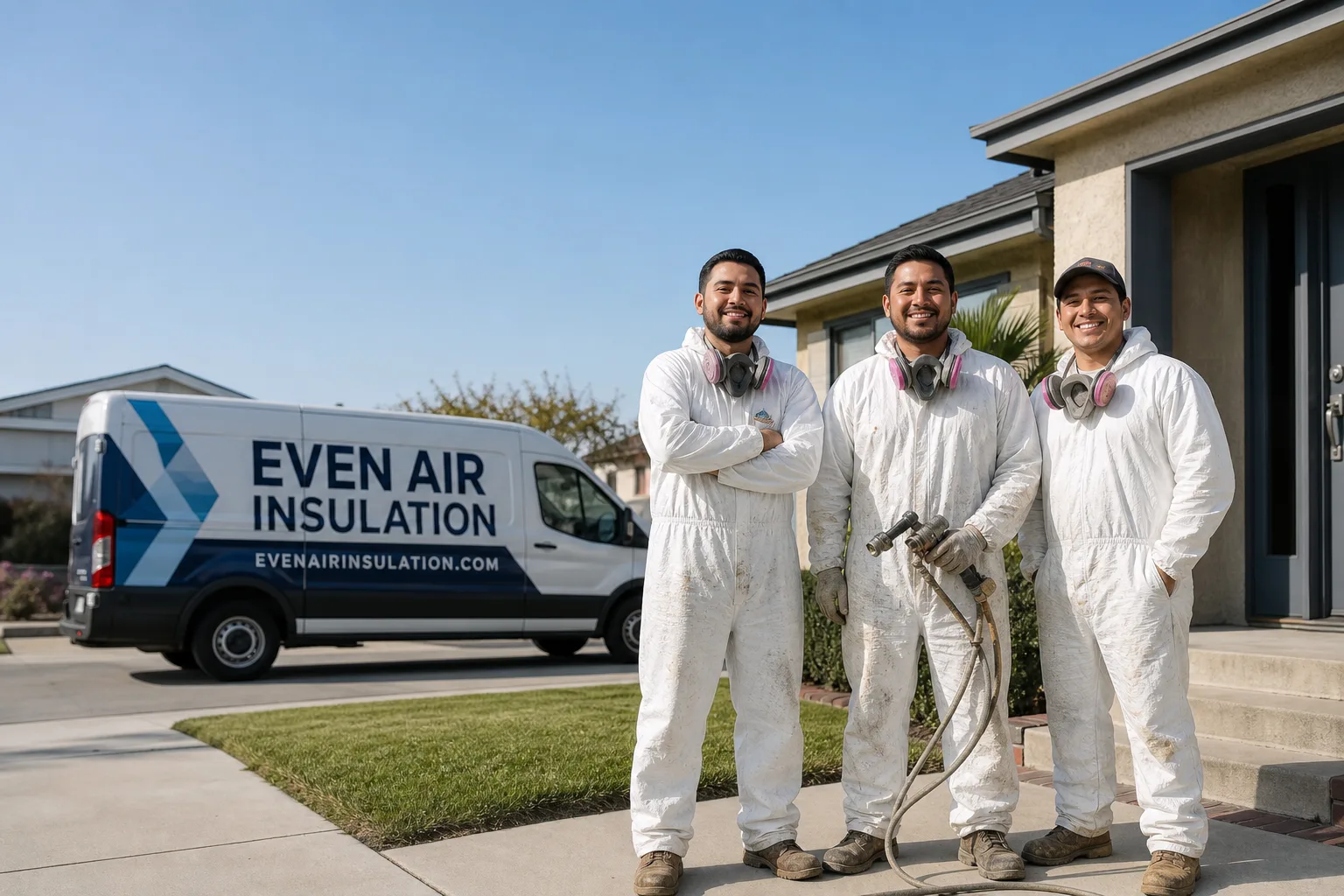
Fast, Reliable Attic Insulation Across East San Gabriel
Attic insulation in East San Gabriel is rarely about staying warm in winter. It’s about surviving July and August without your AC running nonstop while your attic bakes past 140°F under a clay-tile roof. Most homes in the 91776 tract were built between the 1940s and 1960s, long before Title 24 attic insulation requirements existed, and many still have the original thin batts, settled, compacted, and doing almost nothing. Even Air Insulation fixes this the right way: we solve the ventilation problem first, then install the right material for your roof and budget. Call (855) 362-0195 for a free estimate.
If you’re researching Attic Insulation options for your East San Gabriel home, the most important thing to understand is that your clay-tile roof changes the job. A generic insulation contractor will blow material into an unvented tile attic and call it done. It won’t work. We’ll explain why below, and what we do differently.
Why Even Air Insulation Is East San Gabriel’s Preferred Attic Insulation Company
We work in East San Gabriel regularly, and we’ve learned this neighborhood’s homes the way you learn a trade: by being in them. The 1940s stucco ranches off San Gabriel Boulevard, the Spanish-style homes with low-pitch tile roofs east of Del Mar, the older wood-shake roofs near Marshall Fundamental. The common thread is heat gain. Rooftop temperatures under San Gabriel Valley sun push attic spaces well past 140°F, and that heat doesn’t stay in the attic. It radiates down into living space, forcing AC systems to cycle harder and longer all afternoon.
The part most contractors miss: many of these original clay-tile roofs have almost no soffit venting. You can’t just add insulation to an attic that can’t breathe. The new material traps the heat and bakes. Nelson Quirarte, our owner, will tell you the same thing he tells every East San Gabriel homeowner: ventilation comes before insulation, not after. It’s the difference between a fix that works for two decades and a fix that fails in one summer.
We respond to East San Gabriel calls quickly, we show up when we say we will, and we don’t push a single product because it’s what’s on the truck. We carry eight professional-grade brands and match the material to your specific roof and ceiling assembly. That’s the whole job.
Attic Ventilation in East San Gabriel
Attic Ventilation in East San Gabriel is the invisible prerequisite nearly every tile-roof home needs before insulation goes in. If your 1940s or 1950s ranch has its original clay-tile roof, there’s a good chance the attic has minimal or zero soffit venting. Without airflow, attic temperatures in August regularly exceed 140°F, and any insulation you add just absorbs and holds that heat. For these homes, a proper ventilation retrofit, adding soffit intakes and ridge or static exhaust vents, typically runs $900 to $2,200 depending on roof accessibility and how many vents are needed.
Solving tile-roof ventilation before insulation
Pulling a clay-tile roof to add ventilation is a different job than rolling batts into a modern vented attic. The tiles have to come up carefully, underlayment gets inspected, and the vent cuts happen before tiles go back down. We do this work in East San Gabriel regularly because it’s the only way to make insulation function under these roofs.
When ventilation is the real problem
Sometimes a homeowner thinks they need new insulation when the attic is actually starved for air. A quick attic temperature check on a hot afternoon tells us a lot. If the attic is 140°F and the insulation is old but dry and intact, ventilation might solve 70% of the comfort problem on its own.
Radiant Barrier in East San Gabriel
Radiant Barrier in East San Gabriel is one of the highest-impact upgrades you can make under a clay-tile roof, because it attacks the heat source directly. A radiant barrier is a reflective foil material installed on the underside of the roof rafters. It reflects radiant heat back out instead of letting it radiate down into the insulation and living space. In a valley climate where the sun pounds roofs for 10 hours a day, this drops attic temperatures meaningfully. For a typical East San Gabriel ranch, radiant barrier installation runs $1,500 to $3,000 depending on attic size and roof geometry.
How it works with your existing insulation
The radiant barrier and the insulation do different jobs. Insulation slows conductive heat transfer. The foil reflects radiant heat before it reaches the insulation. Combined, the two can cut the cooling load on an attic by a noticeable margin. For East San Gabriel homes with settled batts and no barrier, the result is usually less AC cycling and more even room temperatures.
Tile roofs and low-slope access
Low-pitch roofs mean tight attic spaces. Installing radiant barrier under a low-slope tile roof is slow, careful work with staples, foil, and a headlamp. We’re used to this. It’s not a job to rush, and it’s not a job where you want someone who’s never done a tile-roof attic before.
Trusted Brands We Service in East San Gabriel
We install and service insulation from Owens Corning, GreenFiber, Icynene, and Demilec, among others. The material choice depends on your roof, your ceiling assembly, and the condition of your existing insulation. For East San Gabriel’s tile-roof ranches, we often specify GreenFiber blown-in cellulose for its density and air-sealing behavior, but a spray foam application with Demilec or Icynene makes sense for certain cathedralized or difficult-access ceilings. We keep material lead times short for East San Gabriel customers and we don’t stock just one thing. The right insulation for the job, not just the one we happen to have.
Common Attic Insulation Problems We See in East San Gabriel Homes
- Blowing new insulation into an unvented clay-tile attic. The new material traps 140°F+ heat and bakes instead of insulating. The homeowner pays for insulation that fails before the first summer ends.
- Rolling fresh batts over settled, compacted original batts. The old material has already collapsed to an inch or two in places. Layering over it without air-sealing the ceiling plane just creates a lumpy thermal mess.
- Compressing insulation around old knob-and-tube-era or early Romex wiring. Compression kills R-value in exactly the spots that matter. In a 1950s attic with wiring runs everywhere, this is the difference between an effective job and a decorative one.
- Ignoring the ceiling plane penetrations. Recessed lights, bathroom fan housings, and plumbing vents all leak air. Air-seal the plane first, then insulate. Skipping this step wastes a chunk of the material’s performance.
Pricing for Attic Insulation in East San Gabriel, CA
A full attic insulation replacement in East San Gabriel typically runs $1,800 to $4,200 for a standard 1,000 – 1,400 square foot ranch, depending on material choice and attic access. Blown-in cellulose over existing batts runs $1,200 to $2,500. Attic ventilation work adds $900 to $2,200 on a tile-roof home. Radiant barrier adds $1,500 to $3,000. The factors that drive price: whether we’re removing old material, whether ventilation needs to be solved first, and what the ceiling plane looks like once we’re in the attic. Free estimates are part of the service. Call (855) 362-0195 and we’ll give you a real number, not a vague range over the phone.
We Also Serve Cities Near East San Gabriel
Our team covers East San Gabriel and the surrounding San Gabriel Valley communities, including San Gabriel, Rosemead, Alhambra, and San Marino. If you’re just outside the 91776 tract, call anyway. We’re likely already working in your neighborhood and can schedule you in.
Serving East San Gabriel, CA — Our Local Coverage Area
We’re based in the East San Gabriel area and know this community well. Use the map below to see our service coverage — if you’re nearby, we can almost certainly help.
FAQs About Attic Insulation in East San Gabriel
Yes, almost always. Original clay-tile roofs in East San Gabriel were built with little to no soffit venting, which means attics hit 140°F+ in summer and new insulation just cooks. Ventilation gets solved first, then insulation goes in. Call (855) 362-0195 and we’ll assess your roof before quoting any insulation work.
We work around it carefully and never compress insulation through wiring runs. The key is cutting insulation to fit around wiring without crushing the material, which preserves the R-value in those heated zones. We see knob-and-tube-era and early Romex wiring in East San Gabriel attics constantly, so the crews are used to moving slowly and deliberately.
If the old batts are dry and not full of rodent activity or moisture, blowing over them is usually the right call. The settled material still has some R-value, and removing it adds labor cost without much benefit. If the batts are compacted, damp, or contaminated, removal makes sense first. We’ll inspect and tell you honestly which path fits.
For most tile-roof homes in East San Gabriel, yes. The foil reflects radiant heat from the roof deck before it reaches your insulation, and under a valley sun that’s a significant load reduction. Pair it with ventilation and new blown-in insulation, and the cooling season gets noticeably easier on the AC system.
Yes, without question. East San Gabriel’s climate has long, intense summers and mild winters, so the biggest energy win is stopping summer heat gain. An uninsulated or under-insulated tile-roof attic transfers heat into your living space all afternoon, which drives AC cycling. Adding proper insulation and ventilation cuts that heat transfer dramatically. Summer is when East San Gabriel attics do their damage, and summer is when a proper insulation job pays for itself.
If your East San Gabriel attic is baking your home through the summer, call (855) 362-0195 for a free estimate. We’ll inspect the roof ventilation, look at what’s in the attic now, and give you a straight answer on what needs to happen. Even temperatures. Even energy bills. Even air.
Written by Nelson Quirarte, Owner at Even Air Insulation, serving East San Gabriel and the San Gabriel Valley.