Fast, Reliable Attic Insulation Across Shadow Hills
Attic insulation in Shadow Hills runs $1,800 – $7,500 for a typical custom home, with top-ups starting around $900 and full replacements on multi-acre properties with outbuildings reaching $15,000+. Most jobs are completed in one to two days. If your attic is baking your upstairs rooms this summer, we’re the crew that works with your framing, not against it. Call (855) 362-0195 for a free estimate.
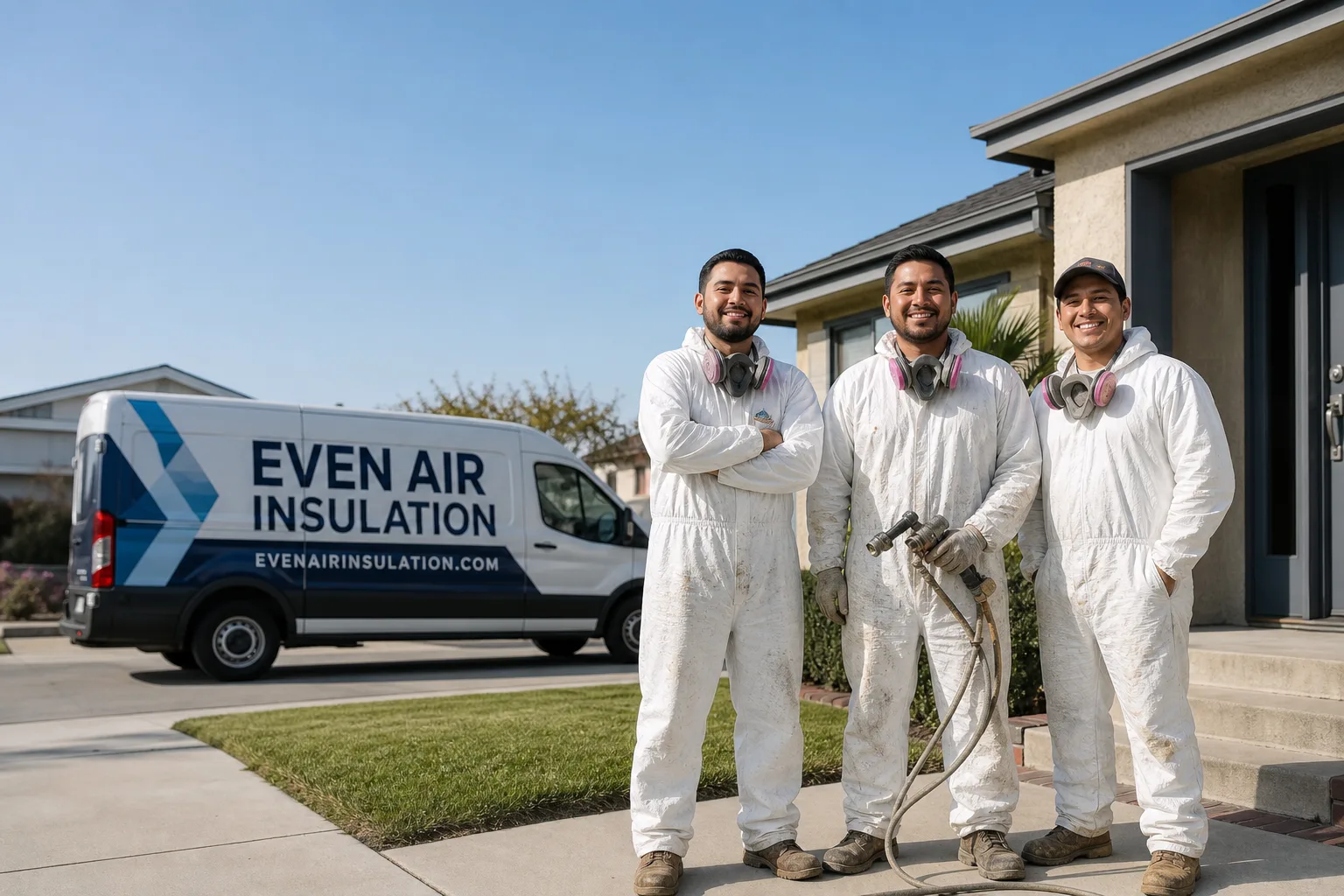
We’ve been in enough Shadow Hills attics to know what we’ll find before we open the hatch. These aren’t tract homes. They’re custom builds, owner additions, and converted barns – each one framed differently. Our Attic Insulation team approaches every property as its own job, not a template. There’s a reason Shadow Hills calls us when the heat won’t quit.
Why Even Air Insulation Is Shadow Hills’s Preferred Attic Insulation Company
We don’t stock one product and force it into every space. We work with eight manufacturers – Owens Corning, Johns Manville, Knauf, Rockwool, CertainTeed, Icynene, Demilec, and GreenFiber – and prescribe the right material for the application. The right insulation for the job, not just the one we happen to stock. That matters in Shadow Hills, where a horse barn, a guest house, and a 1970s addition all present different insulation problems.
Our crews know the local building patterns. The owner-built additions off Stonehurst Drive with irregular framing. The 150°F+ attic temperatures in July. The high-fire-zone detailing requirements that a Burbank contractor might never think about. Nelson Quirarte built this company on technical precision – air-sealing chemistry, dense-pack cellulose technique, and traditional batt work in one shop. That’s why our estimates here are scoped property-wide, not per building.
Attic Mold Removal in Shadow Hills
Attic mold removal in Shadow Hills typically runs $1,200 – $3,800 depending on square footage and contamination depth, and it’s a two-part job: removing the mold, then fixing the ventilation failure that fed it. Horse properties are especially prone – hay stored in barns raises indoor humidity, and when that damp air migrates into an under-ventilated attic, it condenses on the sheathing and feeds mold growth within a season.
What mold removal involves on a Shadow Hills property
We remove degraded insulation and affected sheathing where needed, then treat the structure with an EPA-registered antimicrobial. The follow-through is what matters: we add or repair baffles, unblock soffit vents, and condition the exterior with proper ventilation prep so the attic can dry out. If your house has a detached structure with its own attic, we scope that too. Mold doesn’t stay put.
When to act on attic mold in Shadow Hills
If you smell mustiness upstairs or see staining on the sheathing from the access hatch, get it looked at before fall. Attics sealed up through the hot season with existing mold just cook and spread it. We’ve opened attics where one summer turned a small patch into full-sheathing contamination. The sooner we remove the source, the less gets torn out.
Attic Insulation Removal in Shadow Hills
Attic insulation removal in Shadow Hills runs $1.10 – $1.75 per square foot for old batt or blown-in material extraction, so a 2,000-square-foot attic typically lands between $2,200 and $3,500. You’d want removal if the existing product is compressed, mold-stained, rodent-soiled, or not compliant with ignition-resistant detailing – a common finding in piecemeal-built additions throughout the foothills.
Why removal beats layering over old material
Layering new insulation over degraded product locks in whatever’s wrong underneath: retained moisture, matted R-value, or paper facing that fails fire-zone requirements. A full removal lets us inspect the framing, seal can lights and top plates, and rebuild the thermal envelope clean. It also reveals structural issues you’d never catch otherwise – we’ve found cracked rafters and failed sheathing under old batts.
What removal looks like on a custom home
We use a high-powered HEPA vacuum set up outside, with negative pressure in the attic to keep dust out of your living space. The whole process takes a day for most single-family homes. We bag everything, haul it off, and leave the space ready for new insulation. If you’re in the 91040 ZIP, we’ll also check whether your removed material had any ember-resistant detailing in place – many don’t.
Trusted Brands We Service in Shadow Hills
We service and install Owens Corning radiant-barrier facing, Johns Manville fiberglass batts, Demilec spray foam, and GreenFiber cellulose throughout Shadow Hills. Because we operate from Koreatown with regular routes through the Verdugo foothills, we keep local inventory of these materials available for fast turnaround. If you’re adding a tack room, a guest house, or finishing out a bonus space, we can match the product and the detailing in one visit. Material selection is application-driven, not inventory-driven – the right product for the space, not the easiest one to install.
Common Attic Insulation Problems We See in Shadow Hills Homes
- Compressed batts at knee walls and sloped ceilings. Owner-built additions often have irregular framing, and we routinely find R-30 batts squeezed into 2×4 cavities. That drops effective R-value by half, exactly where the afternoon sun hits hardest on the Verdugo side.
- Unsealed can lights and top plates acting as chimneys. In attics that hit 150°F by midday, any unsealed penetration pulls superheated air into the conditioned space. We air-seal can lights, top plates, and chase runs before installing new material.
- Paper-faced or non-ignition-resistant products in a high-fire zone. Shadow Hills sits in a foothill fire corridor. Paper-faced batts and some foam products don’t pass high-fire-zone detailing requirements. We specify foil-facing, ignition-resistant barriers, and ember-resistant vents instead.
- Attic mold in under-ventilated spaces above horse properties. Hay stored in barns and stables adds indoor moisture that migrates into adjacent attics. Paired with minimal soffit ventilation, the result is condensation, mold, and failed insulation in a single season.
Pricing for Attic Insulation in Shadow Hills, CA
A batt insulation top-up on a standard Shadow Hills attic runs $900 – $2,200. Full blown-in insulation replacement is $2,800 – $6,500 for most custom homes. Spray foam runs $2.50 – $5.50 per board foot, and on multi-acre properties with barns, tack rooms, and workshops, whole-property scopes often hit $12,000 – $18,000. What pushes a Shadow Hills job higher: irregular framing requiring custom cuts, multiple attic zones across outbuildings, and high-fire-zone detailing requirements that mean foil-facing and ignition-resistant products instead of standard paper-faced batts. Your free estimate is itemized by structure so you see exactly where the money goes. Even temperatures. Even energy bills. Even air.
We Also Serve Cities Near Shadow Hills
Our crews regularly work throughout the northeast Valley and foothills, including Sunland, Tujunga, La Crescenta-Montrose, and Burbank. If you’re in one of these communities or anywhere else in the Shadow Hills area, call (855) 362-0195 and we’ll work you into the schedule.
Serving Shadow Hills, CA — Our Local Coverage Area
We’re based in the Shadow Hills area and know this community well. Use the map below to see our service coverage — if you’re nearby, we can almost certainly help.
FAQs About Attic Insulation in Shadow Hills
Shadow Hills attics cross 150°F by midday in July, and the foothill lots sit in a high-fire zone. That means standard paper-faced batts don’t meet ignition-resistant requirements, and radiant barriers need foil facing and ember-resistant detailing rather than typical installation. In basin neighborhoods like North Hollywood or Van Nuys, a basic fiberglass job works fine. Up here, the material choice and detailing both have to account for wildfire exposure. Call (855) 362-0195 and we’ll explain exactly what your attic needs to meet code and the fire zone.
We treat each addition as its own zone. Our estimators map the whole property first – identifying where framing changes between the original build, later additions, and any unpermitted square footage. Each zone gets different detailing based on its orientation, cavity depth, and fire-zone requirements. The quote itemizes everything, so you see which space needs what. We’ve scoped five-zone attics on a single Shadow Hills lot, so nothing about piecemeal construction surprises us.
Yes. These outbuildings are usually uninsulated or thinly insulated, which means they bake in summer and lose heat all winter. A separate plan per structure matters because a barn with hay storage has different moisture control needs than a workshop, and both have different needs from a conditioned guest house. We’ll scope each building independently and recommend materials accordingly – GreenFiber cellulose for the hay loft, for example, or Demilec closed-cell foam for a workshop with metal roofing. Call (855) 362-0195 for a full property walk-through.
Stored hay and livestock respiration raise indoor humidity inside barns, and that damp air migrates into adjacent attics. When the attic isn’t properly ventilated, moisture condenses on sheathing and mold follows. The fix isn’t just mold removal – it’s adding baffles, unblocking soffit vents, and sometimes installing a ridge vent or powered vent to actively move air. We also check that bathroom and kitchen fans aren’t venting into the attic, which compounds the problem. An estimate is free.
We carry Owens Corning and Johns Manville fiberglass products, Demilec spray foam, GreenFiber cellulose, and Rockwool mineral wool, among others. For high-fire-zone attics, we often specify Owens Corning foil-faced batts or a Demilec closed-cell foam with an ignition barrier. The brand depends on the application – not on what’s easiest for us to stock. Call (855) 362-0195 and we’ll walk you through what we’d recommend for your specific roof assembly and fire-zone requirements.
Get Your Shadow Hills Attic Scoped Today
If your upstairs rooms run ten degrees hotter than the rest of the house, your attic is the problem. Even Air Insulation serves all of Shadow Hills, from the horse properties off Stonehurst Drive to the custom estates along La Tuna Canyon and the 91040 ZIP. Our estimates are free, itemized property-wide, and built around your fire-zone requirements and 150°F attic reality. Call (855) 362-0195 to schedule a walk-through with a crew that knows foothill construction. Even temperatures. Even energy bills. Even air.
Written by Nelson Quirarte, Owner at Even Air Insulation, serving Shadow Hills and the northeast San Fernando Valley foothills.