Attic Insulation Pricing Breakdown: What Koreatown Homeowners Pay in 2026
Most Koreatown homeowners will pay between $1,400 and $2,600 to insulate a typical 1,200 square foot attic in 2026, with labor and material choice driving most of the spread. That’s a wide range, and it frustrates people who collect three quotes and can’t figure out why the numbers don’t line up. The short answer is that attic access, what’s already up there, and whether the job includes air sealing create genuinely different scopes. If you’d rather not spend your weekend crawling around up there, call us at (855) 362-0195 for a free estimate.
The bigger problem with Koreatown attic insulation pricing isn’t that contractors are inflating bids. It’s that most quote summaries bundle or omit the three line items that actually move the number: access difficulty, removal of old material, and air sealing scope. A house on Wilshire with a full pull-down hatch and clean joist bays is a half-day job. A 1920s bungalow off Western with a 22-inch scuttle hole and 80 years of compacted debris is a different animal entirely. Same square footage. Radically different labor.
What Actually Drives Attic Insulation Cost in Koreatown
Attic insulation pricing in Koreatown breaks down into materials, labor, prep work, and air sealing. But national averages don’t help you here, because this neighborhood’s housing stock is unusually varied. Within a six-block radius you’ll find 1920s Spanish-style homes with barely accessible attics, 1960s stucco boxes with flat ceiling joists, and newer condo conversions with fire-rated assemblies that require specific materials. Each one prices differently.
Here are the three cost drivers that vary most in Koreatown specifically:
- Attic access difficulty: A full stair or pull-down hatch lets a crew move freely. A scuttle hole, common in older Koreatown homes, means every bag of material and every tool goes up through a 2-foot opening. Labor time can double.
- Existing insulation condition and removal: If the old material is dry, pest-free, and not compacted, blowing new insulation over it is fast. If it’s water-damaged, rodent-contaminated, or packed down to half its original R-value, removal adds cost. In Koreatown, we regularly pull out batts that rodents have tunneled through from decades of roof-adjacent nesting.
- Air sealing scope: Insulation without air sealing is like wearing a down jacket with the zipper open. Sealing top plates, wire penetrations, recessed light housings, and plumbing chases takes time and foam. Some contractors skip it to keep the bid low. We’ll flag that more below.
Those three items, more than material markups, explain why two quotes for the same attic can land $1,000 apart or more.
Material-by-Material Pricing: What Koreatown Attics Cost in 2026
Here’s what we’re seeing for a 1,200 square foot attic in Koreatown this year, assuming clean joist bays and reasonable access. These are installed ranges, not just material costs.
Blown-in fiberglass
$1,100 to $1,900 for R-38, or roughly $0.92 to $1.58 per square foot. Blown fiberglass is the budget workhorse. We use Owens Corning and Johns Manville products for this application. It settles slightly over time, so we calculate settled depth, not just installed depth. Some bids promise R-38 but blow to a depth that settles to R-30 within a year. That’s a documentation issue we’ll cover in the comparison section.
Blown-in cellulose
$1,300 to $2,200 for R-38, or roughly $1.08 to $1.83 per square foot. Cellulose, specifically GreenFiber’s recycled-content product, costs slightly more than fiberglass but fills irregular joist bays better and provides modest air-flow resistance that fiberglass doesn’t. In older Koreatown attics with inconsistent framing, it’s often the better material match. It also suits homeowners who prioritize recycled-content building products.
Batt replacement
$1,500 to $2,400 for R-38 fiberglass batts, or roughly $1.25 to $2.00 per square foot. Batt work makes sense when the attic will be used for storage or mechanical access, or when joist spacing is standard enough that batts install cleanly. We carry Knauf and Owens Corning batt lines for these jobs. The labor is higher than blowing because every piece is hand-cut and fitted.
Partial spray foam for penetrations
$250 to $700 added to any of the above, depending on penetration count. This is what we call the “air sealing pass.” It’s not full-cavity spray foam, which runs much higher. It’s targeted foam around top plates, can lights, flue chases, and plumbing stacks. In a 1,200 square foot Koreatown attic, most homes need 15 to 30 penetration seals. Skipping this saves money on paper and costs it in energy bills for years.
Full-cavity spray foam in a Koreatown attic runs $3.50 to $6.50 per square foot installed, which is a different conversation altogether. It’s not always the answer, but when a home has ductwork in unconditioned space or the attic is semi-finished, it can be. We carry both Icynene and Demilec lines for those situations.
Why Some Koreatown Quotes Are 3x It Apart
We’ve looked at dozens of competitor bids that Koreatown homeowners have shown us. The pattern is consistent. A $900 quote for a 1,200 square foot attic almost never includes air sealing, almost never includes permit fees where required, and almost never documents settled R-value. A $2,800 quote usually includes removal of old material, full air sealing, a permit, and depth verification. Both are “attic insulation.” They are not the same job.
Here are the red flags we tell homeowners to look for in low bids:
- No air sealing line item. If the quote doesn’t mention sealing penetrations, it’s a blow-and-go job. The insulation will perform below spec.
- No permit pull for jobs that require one. In Koreatown, adding insulation beyond a certain scope in some building types triggers permit requirements. A contractor who never mentions permits either isn’t doing the required work or is rolling the dice with your inspection history.
- R-value promised without settled-depth documentation. “R-38 blown” means nothing if the settled depth isn’t calculated. Ask for the number of inches and the settled R-value written on the quote.
- No mention of existing material condition. A bid that doesn’t ask what’s currently up there isn’t a real bid. It’s a placeholder.
We pulled an old fiberglass batt out of an attic over by the Wilshire/Western corridor last year that had compressed to about an inch thick. The homeowner had a quote from another company to blow new material right over it. That would’ve left the house under-insulated and the old material still trapping moisture against the ceiling. The cheap bid wasn’t cheaper.
Rebates and Credits Koreatown Homeowners Should Stack in 2026
California’s TECH Clean California program and the CHEERS rebate pathway both apply to attic insulation work in Koreatown, and they stack with the federal 25C tax credit. Most homeowners we talk to know about one of these but not all three.
The federal 25C tax credit covers 30% of qualified insulation costs, up to $1,200 per year, through 2032. That’s the easiest one to claim. California’s TECH program operates as a rebate administered through participating contractors, and CHEERS functions similarly for qualifying efficiency projects. The specifics shift year to year, so we check eligibility at the time of quoting rather than promising a rebate amount before we’ve seen the project scope.
What matters more than the exact rebate dollar figure is this: the rebate programs generally require documentation that the work met specific R-value targets. A contractor who won’t document settled depth won’t get you the rebate, because the paperwork won’t pass review. Another reason the low bid ends up costing more.
How to Compare Koreatown Attic Insulation Quotes in 2026
Collecting multiple quotes is the right move. Comparing them well is the harder part. Here are the five line items every Koreatown homeowner should require in writing before signing anything:
- Material type and brand. “Blown insulation” isn’t specific enough. The quote should say fiberglass or cellulose, and name the manufacturer. GreenFiber, Owens Corning, Johns Manville, and Knauf all make products that perform differently in different attics.
- Target R-value with settled depth. The quote should state target R-value, installed depth in inches, and settled depth in inches. If all three aren’t there, ask why.
- Air sealing scope. Number of penetrations to be sealed and what materials will be used. This should be a separate line item, not buried in “miscellaneous.”
- Existing material handling. Does the quote include removal, or blowing over existing material? If removal, is disposal included? If blowing over, what’s the existing material’s condition and how was it assessed?
- Permit and inspection status. Who pulls the permit, what does it cost, and does the quote include final inspection?
If a contractor balks at providing any of these five, that’s information. It tells you what kind of job they’re planning to do.
When to Call a Pro Instead of DIY
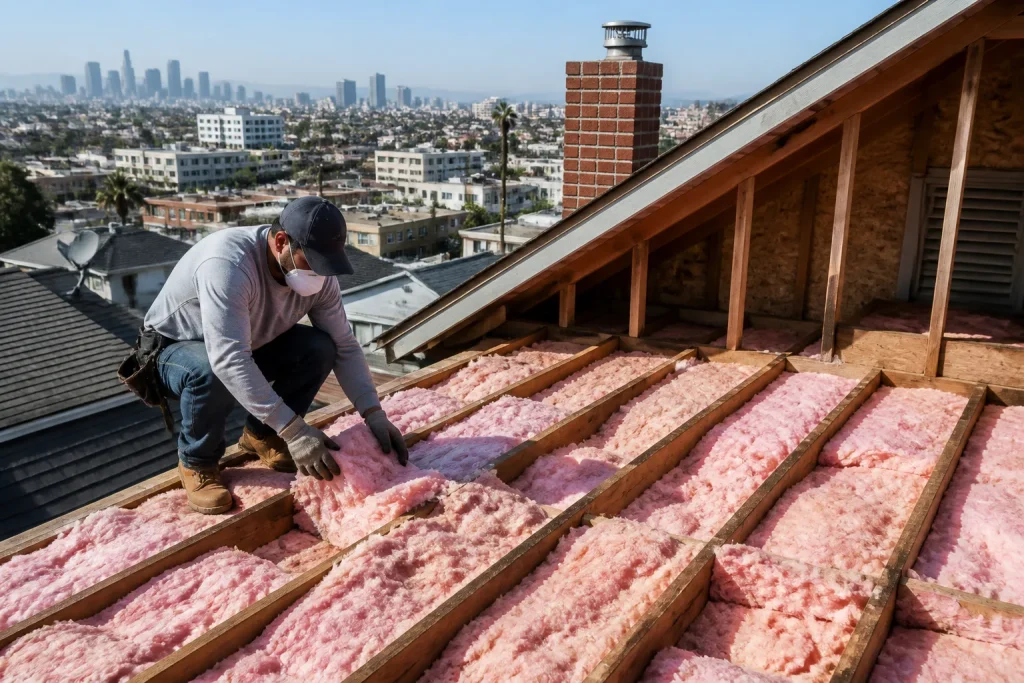
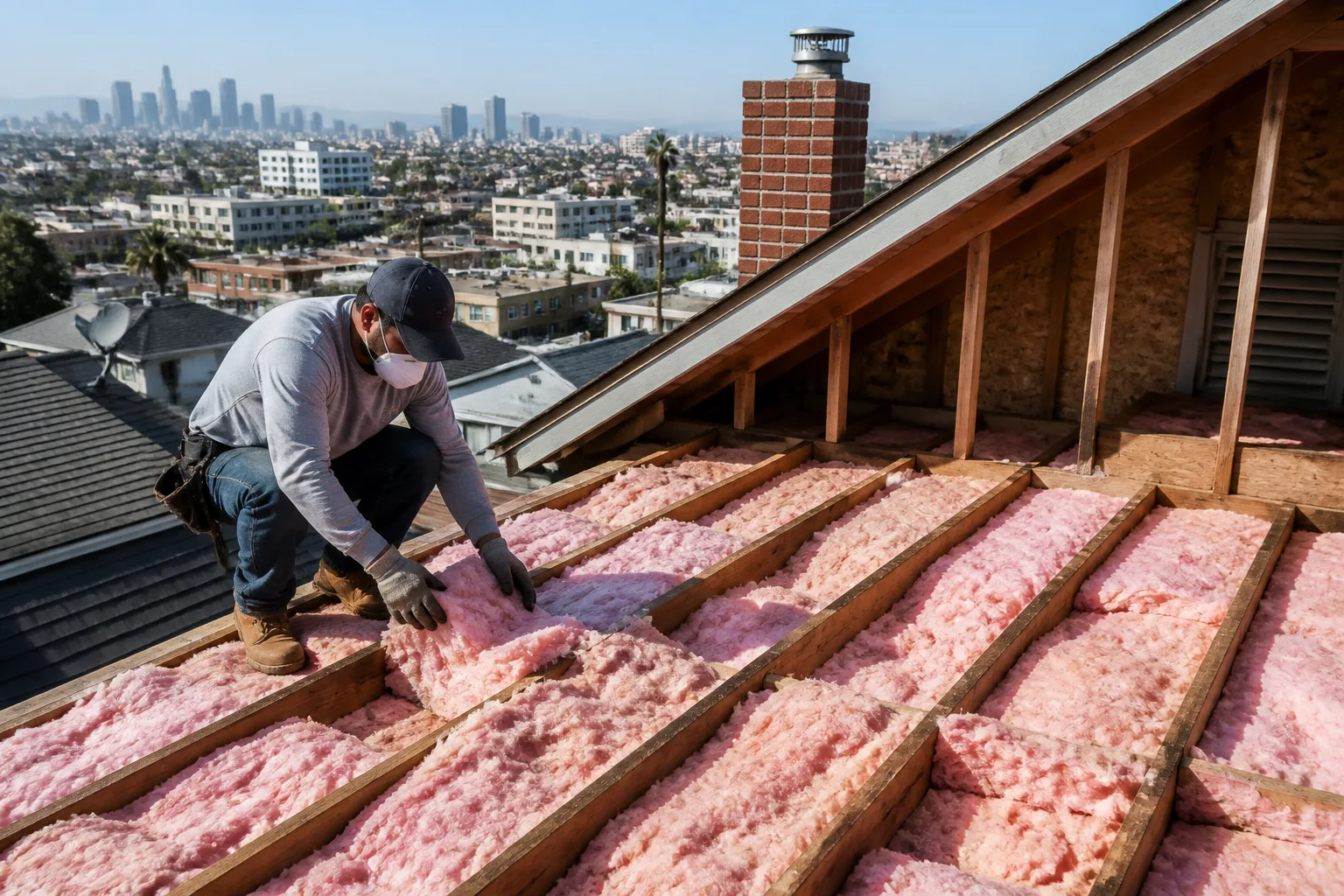
Attic insulation is one of the more accessible home improvement projects, but it has real hazards. Blown-in work requires a two-person crew with a machine running outside and a hose inside. Crawling through an unfinished attic means navigating joists, avoiding ceiling drywall, and working around wiring you can’t always see. Fiberglass particles and cellulose dust require respirators and skin protection. And if your attic has vermiculite insulation from before 1990, it needs professional testing before anyone disturbs it.
We’ve fixed enough DIY jobs in Koreatown to know when the savings evaporate. A homeowner blows in loose fiberglass without air sealing, then has to pay someone to remove it all so sealing can be done properly. The second job always costs more than the first job done right would have.
If your attic has uneven temperatures, high summer cooling bills, or rooms that never hold temperature, the insulation isn’t doing its job. Call us at (855) 362-0195 and we’ll look at what’s up there, what condition it’s in, and what it actually needs. Related services in Koreatown include attic insulation in Rosemead, spray foam insulation in Rosemead, and blown in insulation in Rosemead.
The Bottom Line
Koreatown attic insulation in 2026 runs $1,400 to $2,600 for a typical 1,200 square foot attic, with the spread driven by access, existing material condition, and whether air sealing is included. Material choice matters, but scope matters more. The right product for a 1960s stucco box off Olympic might be GreenFiber cellulose, while a 1920s bungalow near Wilshire does better with Knauf batts and targeted spray foam. The only way to know is to look at the attic, not just the square footage.
If you’re collecting quotes in Koreatown, require the five line items above in writing. If a contractor won’t provide them, you have your answer. And if you want a second opinion on a quote you’ve already received, we’re glad to walk through it with you. Even Air Insulation offers free estimates. Call (855) 362-0195 and we’ll take a look.
For more on how we approach insulation work, start at the Even Air Insulation home page.
Frequently Asked Questions
The average Koreatown attic insulation job runs between $1,400 and $2,600 for a 1,200 square foot attic, depending on access difficulty, whether old material needs removal, and whether air sealing is included. Smaller attics fall below that range; attics with difficult access or contamination run above it. Call (855) 362-0195 for an exact quote, estimates are free.
Blowing over existing insulation is cheaper in the short term, but only makes sense if the existing material is dry, pest-free, and not compressed. If old batts are water-damaged, rodent-infested, or packed down, blowing over them traps moisture and reduces performance. Removal costs more now but avoids a redo later.
Full-cavity spray foam in a Koreatown attic runs $3.50 to $6.50 per square foot installed. Partial spray foam used for air sealing penetrations adds $250 to $700 to a blown-in or batt job, depending on how many penetrations need sealing. The right approach depends on the attic, not on a blanket recommendation.
Yes. The federal 25C tax credit covers 30% of qualified insulation costs up to $1,200 per year through 2032, and California’s TECH Clean California and CHEERS programs offer additional rebates for qualifying attic insulation work in Koreatown. Eligibility depends on documented R-value targets, so make sure your contractor provides settled-depth documentation.
Written by the team at Even Air Insulation, serving Koreatown since 2018.
Need Insulation Help?
Call Even Air Insulation — licensed & insured, here with fast after-hours help in Rosemead.
(855) 362-0195