
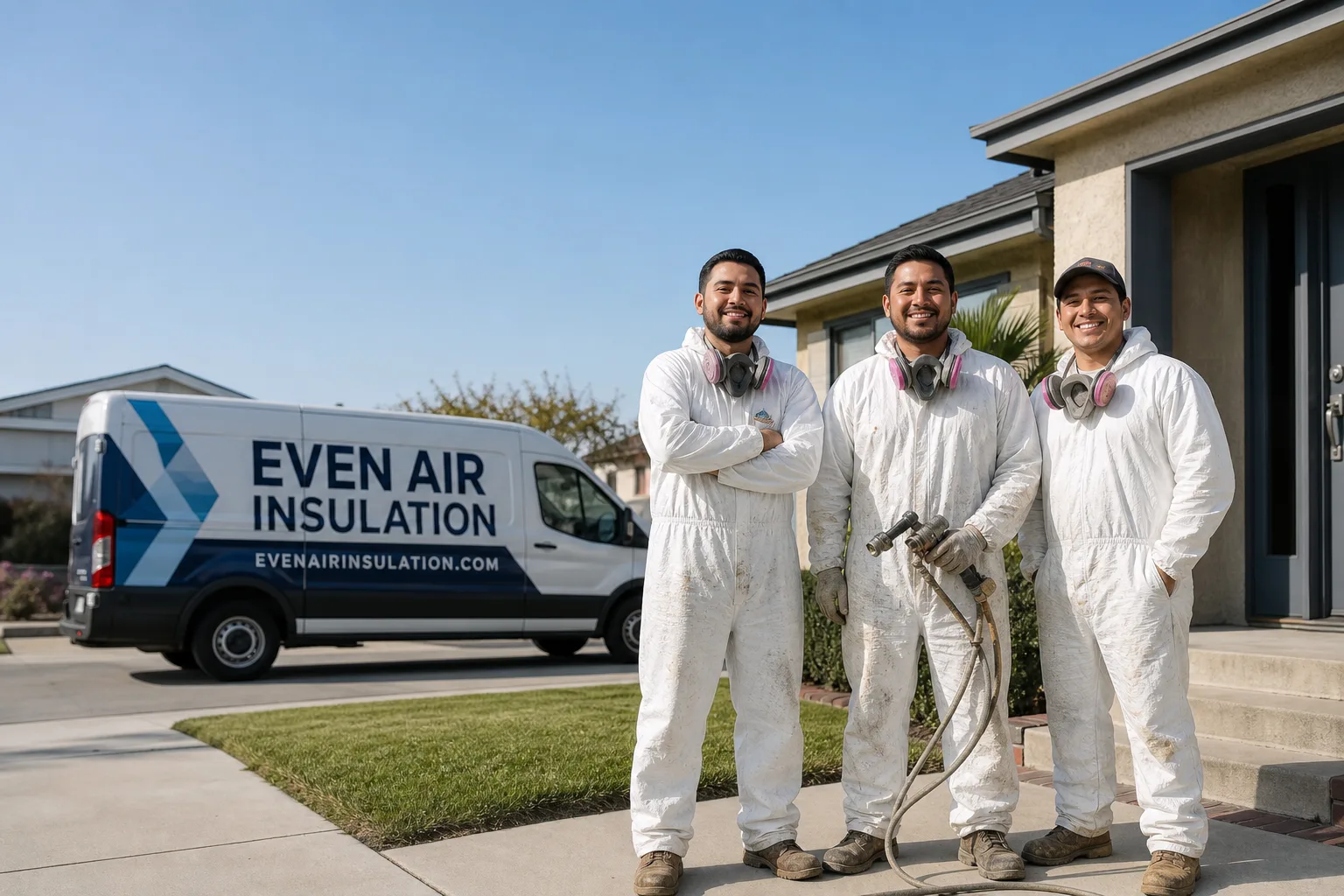
Fast, Reliable Spray Foam Insulation Across Sierra Madre
Spray foam insulation in Sierra Madre has to do two jobs at once: it has to keep foothill heat out during Santa Ana events and hold warmth in on cold, damp canyon mornings. We’re familiar with both conditions because we work in this 91024 and 91025 ZIP code regularly. Even Air Insulation runs crews who know Sierra Madre’s older wood-frame homes and the specific air-sealing challenges they present. Whether you’re dealing with a 1940s ranch with original batts or a 1920s bungalow with uninsulated walls, we can get a crew to your street quickly. Call (855) 362-0195 for a free estimate and we’ll schedule a walkthrough.
Why Even Air Insulation Is Sierra Madre’s Preferred Spray Foam Insulation Company
Most insulation outfits offer one product line and call it a day. We carry eight manufacturer lines because the right material for a 1948 foothill home isn’t always the right material for a post-war tract house on the flats. Nelson Quirarte built Even Air around that principle: material selection is application-driven, not inventory-driven. That’s why we stock Icynene and Demilec for spray foam work, GreenFiber for blown-in cellulose retrofits, and Owens Corning for traditional batt work. Our crews are trained in all three installation methods, so the recommendation you get reflects what your house needs, not what’s easiest for us to install.
Sierra Madre homeowners call us because the homes here are different. The housing stock skews older, much of it built between the 1920s and 1950s with wood-frame construction and raised foundations. Many attics still have original insulation that’s compressed, rat-chewed, or missing entirely. We’ve worked in neighborhoods from the canyon-adjacent streets near Bailey Canyon Wilderness Park to the flatter blocks near Baldwin Avenue, and we understand how much heat loads can vary within a single ZIP code here.
Spray Foam Wall Insulation in Sierra Madre
Spray Foam Wall Insulation in Sierra Madre typically involves dense-pack application into existing wall cavities or open-cell foam sprayed into open stud bays during renovations. In older Sierra Madre bungalows, the walls are often empty. No fiberglass, no rock wool, nothing but studs and siding. That’s why rooms facing the San Gabriels bake in the afternoon while interior rooms stay cold. A typical wall insulation retrofit in a 1,200 to 1,800 square foot home runs $4,000 to $9,000 depending on cavity size and foam type.
For homes without wall insulation, the difference is immediate. Rooms hold temperature longer, the furnace cycles less, and the house stops feeling like a sieve when the Santa Anas pick up.
What to Expect During Installation
Crews drill access holes through exterior siding or interior drywall, inject the foam, and patch the openings. The job usually takes one to two days for a single-story home. We’re careful around Sierra Madre’s older siding materials, which can be sensitive to drilling if not prepped correctly.
Open-Cell or Closed-Cell for Walls
Open-cell foam works well for interior wall cavities because it breathes slightly and allows moisture to move through the assembly. Closed-cell adds structural rigidity and a vapor barrier. In Sierra Madre’s dry climate, either can work, but closed-cell makes sense for homes in the Very High Fire Hazard Severity Zone because of its density and ignition resistance.
Rim Joist Spray Foam in Sierra Madre
Rim Joist Spray Foam in Sierra Madre addresses one of the most overlooked leak points in older raised-foundation homes. The rim joist is the band of wood that runs around the perimeter of your house where the floor framing meets the foundation. In Sierra Madre homes from the 1920s through the 1950s, this area is often completely uninsulated, which means cold air pours in at floor level on winter mornings and hot air works its way up from the crawl space all summer.
Expect to pay between $1,200 and $2,800 for a full rim joist treatment on a typical Sierra Madre home. The exact cost depends on crawl space access and how much debris removal is needed first.
Why Canyon-Adjacent Homes Need This More
In the foothill neighborhoods near the canyon edge, winter mornings routinely dip near freezing while afternoons climb into the 70s. That wide swing means the rim joist never gets a break. Spray foam seals the perimeter and stops the daily air exchange that makes floors feel cold and rooms feel drafty.
The Crawl Space Connection
If your crawl space is vented, the rim joist is the first line of defense against moisture and temperature transfer. Foam applied here also discourages rodents, which are common in the foothill areas of Sierra Madre given the proximity to open canyon land.
Trusted Brands We Service in Sierra Madre
We work with Icynene and Demilec for spray foam, and we keep both open-cell and closed-cell formulations available for Sierra Madre work. That matters because a canyon home with moisture concerns may need a different foam than a flatland home focused purely on heat gain. We also stock GreenFiber cellulose for homes where a homeowner wants a recycled-content approach, and Owens Corning batts for conventional attic and wall jobs. Having all these options under one contractor means we’re not trying to force one product into every home. We recommend what fits the space.
Common Spray Foam Insulation Problems We See in Sierra Madre Homes
- Foam installed over charred leaf litter. In canyon-adjacent streets, the attic often has a layer of dry, charred leaves and ash blown in from past fire seasons. If foam is sprayed directly over this material, it leaves a hidden ignition path. We remove debris and clear vents before application.
- Spray foam over knob-and-tube wiring. Sierra Madre has a lot of 1920s housing stock, and some of it still has knob-and-tube wiring. Foam cannot be applied directly over live knob-and-tube. We work with homeowners to isolate the wiring or rewire before insulating.
- Undersized foam thickness chosen for summer only. Some contractors spec foam for maximum summer heat gain reduction and ignore the cold, damp winter mornings. That leads to condensation on rim joists and musty crawl spaces. The spec has to account for both seasons here.
- Chapter 7A non-compliance. Sierra Madre sits in a Very High Fire Hazard Severity Zone. Any spray foam work in the attic or on exterior assemblies needs to meet Chapter 7A ember-resistance requirements. We see work from other contractors that doesn’t, and it’s an expensive fix.
Pricing for Spray Foam Insulation in Sierra Madre, CA
What you’ll pay depends on the job. Wall insulation retrofits run $4,000 to $9,000. Rim joist work lands between $1,200 and $2,800. If we’re combining attic air sealing with spray foam on the attic floor, that typically falls in the $3,500 to $7,500 range. Garage ceiling spray foam, common in Sierra Madre’s converted garages and ADU projects, runs $800 to $2,000. Closed-cell foam costs more per board foot than open-cell, but it adds structural strength and a vapor barrier, which matters in the fire zone. Call (855) 362-0195 and we’ll walk the house, measure the cavities, and give you a written number before any work starts.
We Also Serve Cities Near Sierra Madre
Our crews work throughout the San Gabriel foothills. If you’re in Arcadia, East Pasadena, Mayflower Village, or Monrovia, we can often schedule a crew the same week as our Sierra Madre appointments. Nelson Quirarte and the team cover these communities as part of our regular service area. Our Spray Foam Insulation team does attic, wall, and rim joist work across the region. Learn more about what we do throughout Sierra Madre and the surrounding foothill communities.
Serving Sierra Madre, CA — Our Local Coverage Area
We’re based in the Sierra Madre area and know this community well. Use the map below to see our service coverage — if you’re nearby, we can almost certainly help.
FAQs About Spray Foam Insulation in Sierra Madre
Yes. Sierra Madre is in a Very High Fire Hazard Severity Zone, so spray foam in attics, roof decks, and exterior wall assemblies must meet California Chapter 7A ember-resistance requirements. This includes ignition-resistant materials at vent openings and proper detailing at the roof-to-wall intersection. We spec foam and accessory materials accordingly. Call (855) 362-0195 to confirm your scope of work meets local code.
Only after the wiring is addressed. Spray foam cannot be applied over live knob-and-tube wiring because it creates a code violation and a fire risk. We coordinate with our clients to bring in a licensed electrician to isolate or replace the wiring first. Once that’s done, we can insulate the walls and attic properly. The right sequence matters here.
Because the canyon microclimate produces wide daily temperature swings. Homes near the foothill edge can see near-freezing mornings and warm afternoons in the same day. An uninsulated rim joist lets cold air pour in at floor level overnight. Spray foam seals that perimeter and stabilizes interior temperatures in a way batt insulation cannot.
Spray foam creates an air seal as well as an insulation layer. That matters in Sierra Madre because the diurnal swing between foothill heat gain and canyon cold is more extreme than in flatland cities. The foam reduces air infiltration at the wall cavities and rim joists, so the house holds steady despite fluctuating outdoor temperatures. Closed-cell foam also helps control condensation during damp winter mornings.
Have it removed before any insulation work. We find charred leaf litter and ash in attic vents on many canyon-adjacent Sierra Madre homes, especially after fire seasons. This debris needs to be cleared and the vent openings inspected for proper ember-resistance before foam is applied. Our crews handle this as part of the prep work. Call (855) 362-0195 for a full attic assessment and a free estimate on the cleanup and insulation together.
Written by Nelson Quirarte, Owner at Even Air Insulation, serving Sierra Madre and the San Gabriel foothills.