
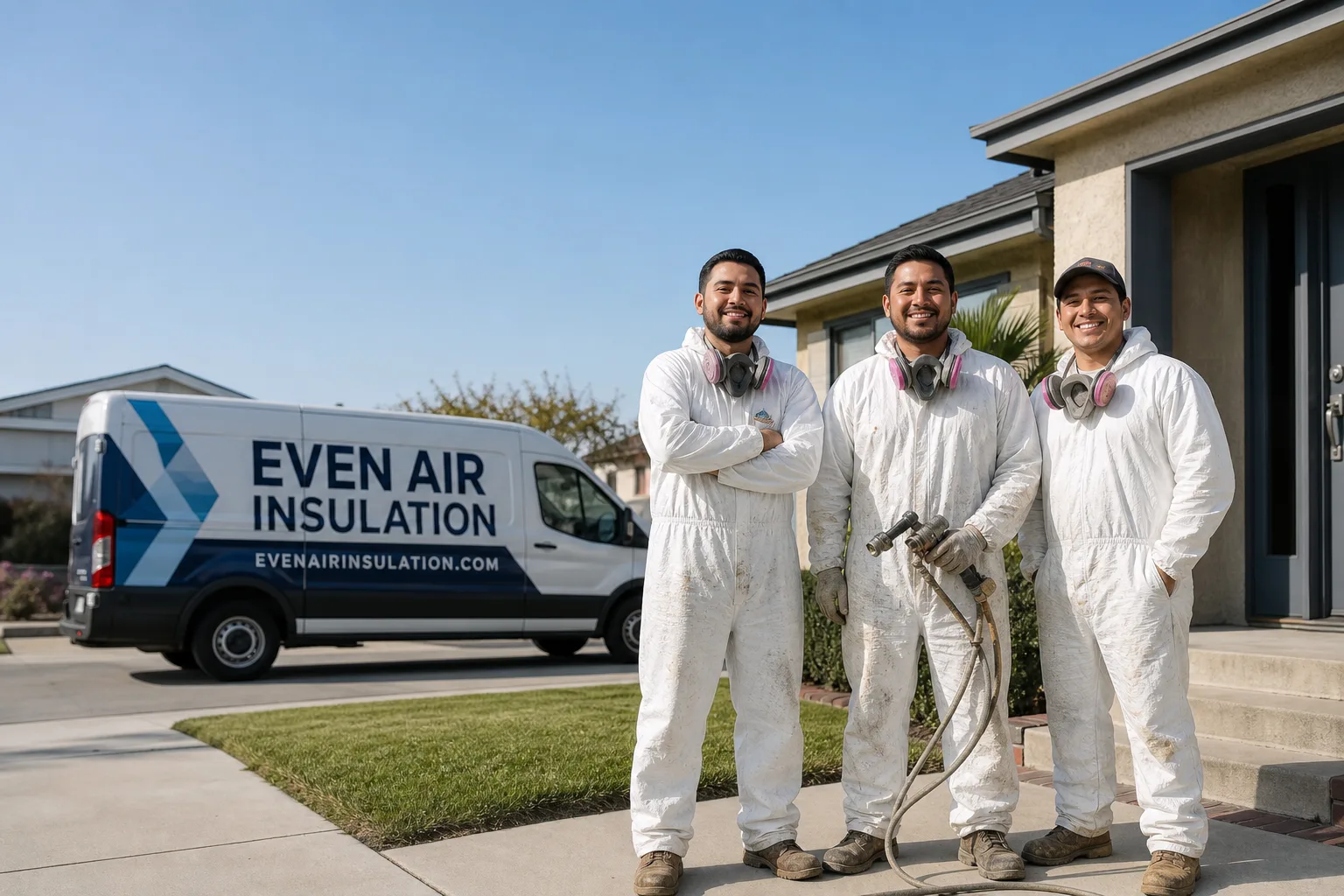
Fast, Reliable Spray Foam Insulation Across Long Beach
Spray foam insulation in Long Beach typically runs $2,800 – $7,200 for a full attic or wall project, depending on whether you choose open-cell or closed-cell foam and how much prep work your home needs. Most Long Beach jobs we schedule are completed in one or two days, start to finish. If your bungalow off 4th Street or your tract home in Los Altos is fighting uneven temperatures, rising energy bills, or stale air, call us at (855) 362-0195 for a straight answer and a free estimate.
We work in Long Beach week in and week out, from the craftsman-lined streets of Rose Park to the condo towers downtown. Nelson Quirarte and the crew know what these houses need because we’ve crawled through hundreds of attics here, most of them built before 1960 with framing and wiring that demand a careful hand. You don’t need a generic insulation contractor. You need someone who understands what marine air does to a 90-year-old roof deck.
Why Even Air Insulation Is Long Beach’s Preferred Spray Foam Insulation Company
Homeowners in Long Beach call us because we recommend the right material for the house, not the easiest one to install. We carry both Icynene and Demilec spray foam lines, which means we can offer open-cell and closed-cell formulations depending on what your walls, roof, and moisture situation actually call for. Most contractors stock one foam and sell it to every home. That approach fails in a city where the coastal zone and the inland flats behave like two different climates.
Our reputation in Long Beach comes from showing up on time, keeping the work area clean, and explaining what we’re doing and why. Nelson Quirarte oversees every local estimate personally, and his background means you get a technical answer when you ask why we’d use open-cell on your interior walls but closed-cell on your rim joists. We answer calls from Long Beach homeowners usually within the hour, and emergency scheduling for moisture-related foam failures gets same-week priority.
Our Spray Foam Insulation team has handled everything from small rim joist jobs in Carson Park condos to full roof deck retrofits in Naples. That depth of local experience matters. A crew that’s only done new construction in Orange County won’t recognize the signs of a failing 1940s paper-backed batt job the way we do.
Closed Cell Spray Foam Insulation in Long Beach
Closed cell spray foam insulation in Long Beach is the go-to choice for rim joists, unvented crawl spaces, roof decks, and any surface that faces persistent moisture from the marine layer or proximity to the harbor. It cures rigid, adds structural strength, and acts as a vapor barrier at about two inches of thickness. In Long Beach, a closed-cell rim joist job typically runs $1,800 – $3,400. A full closed-cell attic or roof deck runs $5,500 – $9,000.
The catch, and it’s one most generic guides skip entirely, is that closed-cell foam on the underside of roof sheathing in an unvented attic can trap marine-layer moisture in the sheathing itself. In Belmont Shore and Naples, where the morning stratus rolls in off the water most of the year, this failure mode shows up as delaminating roof decking and a musty smell that never quite goes away. Closed-cell foam needs a dew-point analysis and often a ventilation strategy. We plan for that before we ever spray a single pass.
Where Closed Cell Earns Its Cost
For Long Beach homes within a mile of the water, closed-cell is the right call for rim joists and crawl space walls. The foam’s density resists the salt-laden air that corrodes and degrades lesser materials. It also adds shear strength to older framing, which matters in a city with as much pre-1950 construction as Long Beach. We carry Demilec closed-cell products for exactly these applications.
When Closed Cell Is the Wrong Fit
If your attic is unvented and you’re not planning to add soffit and ridge vents, closed-cell against the roof deck can create condensation problems you didn’t have before. On the ocean-close flats of 90803, we steer homeowners toward open-cell for attic floors and reserve closed-cell for the rim joist, the crawl space, or a properly planned roof deck assembly with ventilation. That’s application-driven material selection, and it’s why we stock multiple product lines.
Open Cell Spray Foam in Long Beach
Open cell spray foam in Long Beach is the workhorse for attic floors, interior wall cavities, and sound control between rooms. It expands to roughly 100 times its liquid volume, fills gaps and cracks completely, and remains vapor-permeable, which means moisture can still pass through rather than being trapped behind a barrier. In Long Beach, an open-cell attic floor install on a typical 1,200-square-foot bungalow runs $2,400 – $4,800.
That vapor-permeable quality makes open-cell the safer default for Long Beach’s coastal humidity. It lets the assembly dry toward the interior if moisture gets in, which matters in a city where the marine layer can keep relative humidity above 70% for weeks at a time. Open-cell is also noticeably quieter than closed-cell, so homes in the 90802 and 90803 zones, where you hear harbor horns and 710 freeway traffic at night, benefit from the sound dampening.
Attic Floors and Ceiling Lines
For the 1920s through 1950s houses that dominate Long Beach’s central and coastal neighborhoods, an open-cell attic floor install is the highest-return air sealing job we do. It cuts stack effect in summer, keeps conditioned air where it belongs, and costs far less than a full wall retrofit. We pair it with air sealing around top plates and penetrations. Without that air sealing, the foam only gets you partway.
Interior Walls and Sound Control
In Long Beach’s condo and duplex infill, where you share walls with neighbors, open-cell in the party wall cavity makes a real difference. It’s what we’d recommend for a downtown loft with bedroom walls backing onto a hallway, or a craftsman duplex in Rose Park with a thin dividing wall. The material damps noise without the rigidity of closed-cell, which can telegraph sound through framing.
Trusted Brands We Service in Long Beach
You researched brands before you called. We respect that. Even Air Insulation works with eight established manufacturers, and for Long Beach spray foam specifically we lean on Icynene and Demilec product lines. Demilec’s closed-cell formulations give us a rigid, moisture-resistant option for rim joists and crawl spaces near the water. Icynene’s open-cell products provide the vapor-permeable attic floor coverage our coastal bungalows need. We also carry Owens Corning and Johns Manville batt products for jobs where a section of wall just needs a clean re-insulate rather than foam. Having multiple brands on hand means we’re never forcing a material that’s wrong for your house.
Common Spray Foam Insulation Problems We See in Long Beach Homes
Long Beach’s housing stock produces a specific set of recurring spray foam issues. Here’s what we find most often, and how we’d approach the fix if we were in your attic:
- Closed-cell on unvented roof sheathing trapping moisture. We see this mostly in the ocean-close zones of 90803 and 90802, where foam was applied to the underside of the roof deck without any ventilation strategy. The result is sheathing rot and a musty odor that worsens every winter. The fix is a ventilation retrofit, and sometimes the foam has to come out and go back in properly.
- Foam over knob-and-tube wiring. This is a frequent finding in pre-1950 Long Beach bungalows. Spray foam encasing active knob-and-tube creates an overheating hazard, and it’s a code violation. An older home with original wiring needs the electrical system addressed, at least the affected circuits, before foam goes in.
- Foam applied over damp paper-faced batts. In Belmont Shore and Naples, we regularly pull back 1940s paper-backed fiberglass that’s sagging and damp against stucco walls. Spraying foam over that traps the moisture and leads to hidden mold growth. The old material has to come out, the wall cavity has to dry, and then the foam goes in.
- Adhesion failure on salty, dusty surfaces. Homes near the port and the 710 corridor accumulate a fine film of salt and particulate on attic surfaces. Foam needs a clean, dry substrate to bond properly. We clean and prep before spraying, which some crews skip to save time. Skipping it means the foam can delaminate within a few years.
Pricing for Spray Foam Insulation in Long Beach, CA
Here’s what you can expect to pay in Long Beach right now. These are local market ranges, not national averages:
- Open-cell attic floor: $2,400 – $4,800 for a typical 1,000 – 1,500 sq ft bungalow
- Closed-cell rim joist package: $1,800 – $3,400 depending on linear footage
- Open-cell wall cavity retrofit: $3,500 – $6,500 for a single-story home
- Closed-cell roof deck (with ventilation planning): $5,500 – $9,000
What moves the price in Long Beach is the age of the house and the condition of what’s already up there. Pre-1950 homes with original batts, unvented attics, and knob-and-tube add prep and removal time. Condos and townhomes with shared walls tend to run lower on square footage but higher on access and containment. Estimates are free, and Nelson will walk you through the number in plain English before anything gets scheduled.
We Also Serve Cities Near Long Beach
Our crew covers the full harbor area and the 405 corridor, so if you’re in Signal Hill, Lakewood, Carson, or West Carson, the same team that handles Spray Foam Insulation in Long Beach can get to you, usually within the same week. Same materials, same moisture-first planning approach, same crew. Call our Long Beach line for a free estimate wherever you are nearby.
Serving Long Beach, CA — Our Local Coverage Area
We’re based in the Long Beach area and know this community well. Use the map below to see our service coverage — if you’re nearby, we can almost certainly help.
FAQs About Spray Foam Insulation in Long Beach
No, if the job is planned correctly. The real question is foam type and ventilation. Open-cell foam is vapor-permeable and lets moisture move through the assembly. The moisture problem you hear about comes from closed-cell foam applied to unvented roof sheathing in humid coastal air, which is a real risk in Belmont Shore and Naples if you skip the dew-point analysis. We plan for Long Beach’s marine humidity before recommending any foam type. Call (855) 362-0195 and we’ll explain what your specific attic needs.
No, and you shouldn’t let anyone else do it either. Encasing live knob-and-tube wiring in foam creates an overheating hazard and violates electrical code in California. In Long Beach’s pre-1950 housing stock, we find knob-and-tube often. The affected circuits need to be decommissioned and replaced before foam goes into those cavities. We’ll identify it during the estimate and coordinate a plan that keeps you safe.
Open-cell is vapor-permeable, softer, and better for attic floors and interior walls where you want air sealing plus moisture movement. Closed-cell is rigid, acts as a vapor barrier, and works for rim joists and crawl spaces facing persistent dampness from the marine layer. For most Belmont Shore homes, the right answer is open-cell in the attic and closed-cell at the rim joist. The wrong answer is one material everywhere. We stock both.
It depends on where the foam goes. Closed-cell foam is itself a vapor barrier at sufficient thickness, so adding another one can create a double vapor barrier that traps moisture. Open-cell needs no vapor barrier in most Long Beach wall and attic applications. The key variable is whether the surface faces the ocean-close humid zone or the drier inland edge. We’ll be specific about your house, not give you a one-size-fits-all answer.
Spray foam’s primary air quality benefit is air sealing. In Long Beach neighborhoods like 90810 and the western edge of 90802, where diesel particulates and refinery emissions are a daily concern, sealing the attic floor and rim joists cuts the stack effect that pulls outside air up through the house. Combined with proper filtration, that means fewer harbor and freeway pollutants moving through your living space. It’s one of the reasons air sealing matters more here than in inland cities.
Talk to a Long Beach Insulation Specialist Who Knows This City
If you live in a 1920s craftsman in Rose Park, a Spanish-revival bungalow in Belmont Shore, or a 1970s tract home in Los Altos, your insulation needs are not the same as a house in Irvine or Riverside. We know those houses. We know what the marine layer does to them. We know which foam goes where and when it’s the wrong tool entirely. That’s the whole point of being a multi-method specialist with eight brands on the roster.
Call (855) 362-0195 for a free estimate. Nelson Quirarte will answer your questions directly, visit your attic if needed, and give you a number that makes sense for your house. No pressure, no generic pitch.
Written by Nelson Quirarte, Owner at Even Air Insulation, serving Long Beach and the surrounding harbor communities.