
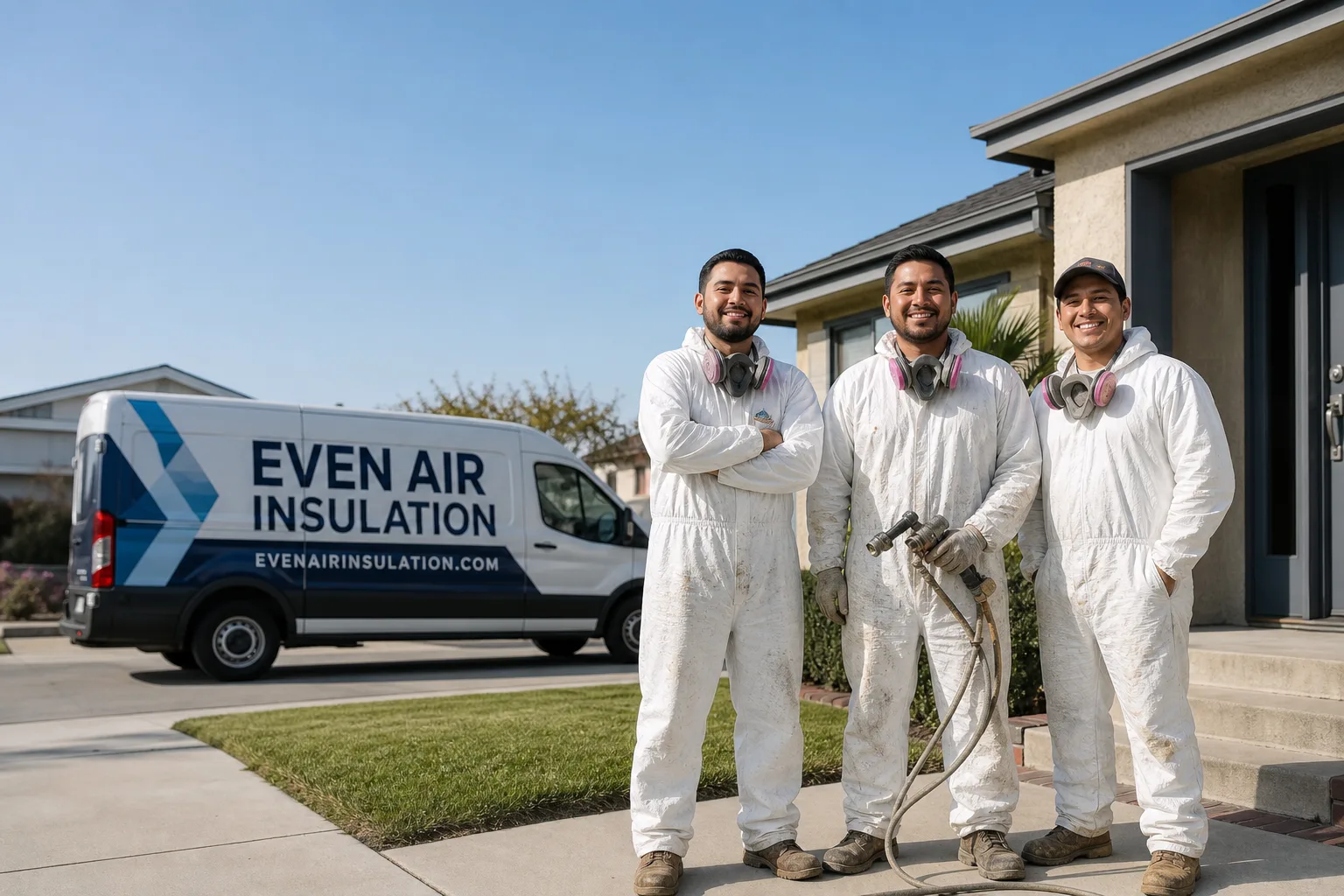
Fast, Reliable Spray Foam Insulation Across Koreatown
Spray foam insulation in Koreatown runs $1.80 – $3.40 per board foot for open-cell and $2.90 – $5.10 for closed-cell, with most garage ceiling jobs landing between $1,400 and $3,200. We’re in the neighborhood regularly, which means most estimates happen within 24 to 48 hours and crews can often start within the week. If your top-floor unit bakes every summer or you hear every step from the neighbors above, call Even Air Insulation at (855) 362-0195 and we’ll tell you straight whether spray foam is the right fix, or whether something else makes more sense for your building.
We know Koreatown’s housing stock because we work in it every week: mid-century stucco garden courts, low-rise walk-ups off Wilshire and Olympic, the prewar duplexes near the edges of the neighborhood. The buildings have quirks. The roofs get hot. The party walls leak air and sound. Spray foam isn’t always the answer, but when it is, we have two professional-grade options through Icynene and Demilec, and we’ll spec the right one for your roof, your walls, or your garage ceiling. That’s the whole point: the right insulation for the job, not just the one we happen to stock.
Why Even Air Insulation Is Koreatown’s Preferred Spray Foam Insulation Company
Our lead installer and owner, Nelson Quirarte, has spent years working inside Koreatown’s specific building types: 1960s-to-80s wood-frame garden apartments with flat or low-pitched roofs, stucco cladding, and attic spaces that were often insulated with thin batting that’s long since slumped and compacted. That experience matters because spray foam in Koreatown isn’t the same job as spray foam in a newer single-family house in Hancock Park. In attached, stacked construction, air leaks double as sound leaks. Knowing where those leaks hide is the difference between a thermal fix and an acoustic fix, and tenants usually need both.
We carry an eight-brand roster spanning spray foam, blown-in cellulose, mineral wool, and fiberglass, which means when Nelson walks your building he’s comparing options, not pitching one product. For a south-facing flat roof deck in Koreatown, that often means closed-cell Demilec. For a shared garage ceiling under a top-floor unit, sometimes open-cell Icynene is the better match. The point is you get a recommendation based on your building, not our inventory.
And because Koreatown is dense and parking is tight, we plan around it. Our crews work in garden courts and tuck-under garages where staging space is limited. We show up with the equipment sized for the access you actually have, not the access a suburban attic would offer.
Garage Spray Foam Insulation in Koreatown
Garage spray foam insulation in Koreatown is the fix for two very specific problems: a garage ceiling that radiates heat into the unit above it, and a shared garage wall that transmits noise between attached neighbors. In the tuck-under parking garages common to Koreatown’s garden courts, the ceiling is the floor of someone’s living room. Uninsulated, that concrete or wood-framed deck soaks up heat from the garage below and stomping footsteps travel straight up. Spray foam applied to the garage ceiling in Koreatown typically runs $1,400 to $3,200 depending on square footage and whether you need open-cell for sound or closed-cell for thermal and vapor control.
Most Koreatown garage foam jobs take one day. The foam cures within hours, and within 24 the garage is usable. We recommend this work before summer peaks, especially for top-floor units where the garage ceiling faces west and catches afternoon sun.
Two Angles On A Garage: Thermal and Acoustic
The shared garage is where heat and noise problems collide. A parked car’s engine heat rises into an uninsulated ceiling deck, and in a tuck-under setup that deck is your floor. Sealing it with closed-cell foam blocks that heat transfer and also stiffens the assembly, which cuts footfall noise from the garage into the unit above.
For attached garages that share a wall with a neighbor’s unit, open-cell foam has a noise-reduction coefficient that closed-cell doesn’t match. In some Koreatown buildings, the right spec is a hybrid: closed-cell at the ceiling for thermal, open-cell at the party wall for acoustic. We’ll prescribe what your specific garage actually needs.
Before You Park On It: What To Check
Look at the ceiling deck in your garage. If you can see exposed joists, you have no thermal break between the garage and the living space above. If the ceiling is finished but the room above still runs hot in summer, the older batting above that drywall has likely compacted. Both are common in Koreatown’s 1960s-to-80s garden apartments, and both are fixable with spray foam in a single pass.
Closed Cell Spray Foam Insulation in Koreatown
Closed cell spray foam insulation in Koreatown is the spec we reach for on south-facing flat roof decks, where the Mediterranean sun bakes the underside of the roof assembly from June through October. Closed-cell cures to a dense, rigid foam that acts as both thermal insulation and an air barrier, which matters when top-floor units run 10 to 15 degrees hotter than the floors below. Expect closed-cell in Koreatown to run $2.90 to $5.10 per board foot, with most roof-deck and attic cap jobs landing between $2,600 and $6,800 depending on depth and square footage.
Closed-cell is not a default. It’s the right call on the underside of a hot flat roof where moisture control matters and where the assembly needs rigidity. In Koreatown’s sun, an open-cell spec on a roof deck without a proper vapor strategy can fail. Closed-cell removes that variable.
Should You Use Closed-Cell Under A Flat Roof?
Here’s how we think about it: Koreatown’s flat and low-pitched roofs face direct sun for most of the year. The roof deck heats up and radiates downward into top-floor units. Closed-cell foam applied to the underside of that deck creates a continuous thermal and air barrier that open-cell can’t match at the same depth. For a south-facing garden-court building where the top unit is already uncomfortable, this is the product we recommend most often.
What A Proper Roof Deck Job Actually Involves
The crew accesses the attic or roof cavity, clears out any degraded batting, seals the wall-top plates and penetrations, and applies closed-cell to the deck at the specified depth. In a 1970s Koreatown garden court, the wall tops between stacked units are usually wide open, and sealing those at the same time closes off the sound path as well as the air path. One pass, two problems solved.
Trusted Brands We Service in Koreatown
We carry Demilec and Icynene spray foam products because they give us both open-cell and closed-cell lines, each with specifications that fit different moisture, thermal, and structural conditions common in Koreatown’s older attached housing. Where blown-in fiberglass or cellulose is the better call, we spec Owens Corning, Johns Manville, or GreenFiber. For fire-resistance and sound control in shared-wall applications, we offer mineral wool through Rockwool. Same crew, eight brands, one recommendation: the right material for your building, not the easiest one for us to install.
Common Spray Foam Insulation Problems We See in Koreatown Homes
- Slumped, useless attic batting in 1960s-80s garden apartments. The original insulation in many Koreatown walk-ups has compacted to a thin mat, leaving the south-facing roof deck exposed to full sun with no effective thermal barrier. Top-floor units absorb that heat all afternoon.
- Open, unsealed party-wall and ceiling penetrations between stacked units. Air leaks at wall-top plates double as sound leaks between neighbors. Spray foam applied only at the roof deck misses the acoustic path entirely, and tenants keep complaining.
- Open-cell foam mis-specified under hot flat roof decks. In Koreatown’s summer sun, open-cell on the underside of a flat roof without proper vapor control can trap moisture. Closed-cell is usually the correct spec here, not a generic open-cell application.
- Garage ceilings as uninsulated heat radiators. Tuck-under garages common in Koreatown’s garden courts bake the unit above. The concrete or wood deck absorbs the sun and the car’s engine heat, then radiates it upward all evening.
Pricing for Spray Foam Insulation in Koreatown, CA
Spray foam in Koreatown is priced by the board foot and by job type. Open-cell runs $1.80 to $3.40 per board foot; closed-cell runs $2.90 to $5.10. A typical garage ceiling job runs $1,400 to $3,200. A roof-deck cap on a one-bedroom top-floor unit runs $2,600 to $5,100. A full garden-court attic with party-wall sealing can run $6,000 to $12,000 depending on square footage, access complexity, and whether we’re carting out old batting first. Parking and staging constraints in dense Koreatown blocks can add labor hours, but we’ll quote that upfront and line-item it so you can see exactly what you’re paying for. Call (855) 362-0195 and Nelson will walk the building with you, free of charge.
We Also Serve Cities Near Koreatown
Our crews regularly handle spray foam work across Koreatown and the surrounding areas, including Los Angeles, Echo Park, Silver Lake, and Hollywood. The building stock changes block to block out here: a Hancock Park single-family attic is a different job than a mid-city garden court. We spec for the structure, not the zip code. Learn more about our Spray Foam Insulation approach and how we match material to the application.
Serving Koreatown, CA — Our Local Coverage Area
We’re based in the Koreatown area and know this community well. Use the map below to see our service coverage — if you’re nearby, we can almost certainly help.
FAQs About Spray Foam Insulation in Koreatown
Because the wall-top penetrations and party-wall caps between your unit and the neighbor’s were never air-sealed. New batting on the attic floor slows conductive heat, but hot air still moves through open gaps at the wall tops, and sound travels the same path. Sealing those penetrations with spray foam while insulating the roof deck is the fix. Call (855) 362-0195 and we’ll show you exactly where your leaks are.
Yes, and in Koreatown’s stacked garden courts this is often the primary reason landlords call us. Closed-cell foam at the ceiling deck and wall-top caps dramatically reduces footfall and voice transfer between units because it closes the same air paths that carry sound. One product, two problems.
Closed-cell is the right call for the underside of a hot flat roof in Koreatown’s summer sun, where the roof deck radiates heat downward into top-floor units and moisture control becomes critical. Open-cell can work in specific wall or garage-ceiling applications, but on a sun-baked roof deck, closed-cell’s density and vapor resistance make it the spec we recommend. We carry both through Demilec and Icynene, and we’ll prescribe based on your roof.
Spray foam applied to a garage ceiling or shared wall does both: it contributes to the building’s thermal envelope for Title 24 compliance and it directly improves comfort and acoustics for the unit above or beside the garage. In Koreatown’s multifamily stock, the two goals usually overlap because the same air gaps drive both heat and noise complaints.
If your building’s attic and party walls have open penetrations, spray foam is worth it because it air-seals while it insulates, which batting alone cannot do. In a 1970s Koreatown garden court, replacing the old batting without sealing the wall tops and party-wall caps leaves the stack-effect and noise paths wide open. Spray foam solves both in one pass, and that’s the job your tenants will actually notice.
Written by Nelson Quirarte, Owner at Even Air Insulation, serving Koreatown and surrounding Los Angeles neighborhoods.